Centrend

Managed IT Services

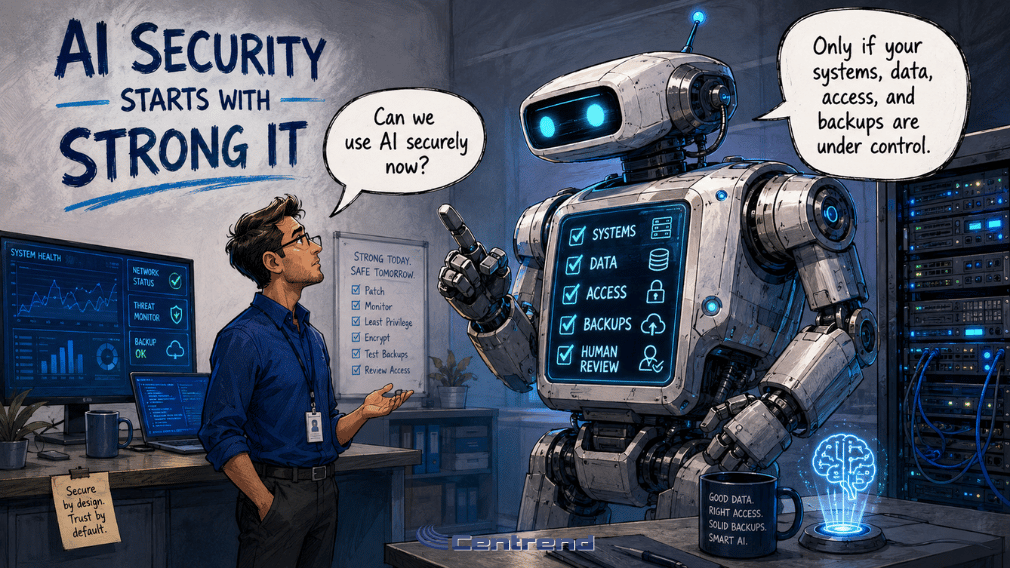
AI Security Starts With Strong IT illustration showing an IT professional asking a large AI robot if AI can be used securely, while the robot explains that systems, data, access, and backups must be under control.

AI Security Starts With Strong IT

AI Security starts with the systems, data, and controls behind the tool. AI can help teams work faster. It can support reports, emails, research, customer replies, workflows, and daily decisions. But if the IT environment is weak, AI can create more risk than value. Outdated systems.Messy data.Loose access.Unprotected backups.Unclear review. That is where AI security problems begin. Why this matters Many businesses are excited to use AI. That makes sense. AI can reduce repetitive work, organize information, and help teams move faster. But AI does not work in a vacuum. It depends on the systems connected to it. If those systems are outdated, disconnected, or poorly secured, AI can pull from the wrong information, expose sensitive data, or speed up mistakes. A smart AI strategy needs a strong IT foundation first. The problem AI can move fast. So can risk. When AI is connected to weak systems, it may: The issue is not always the AI tool. Sometimes, the bigger issue is the environment around it. Strong IT makes AI safer Before scaling AI, businesses should ask: If the answer is unclear, the business may not be ready to expand AI yet. What AI security should include 1. Reliable systems AI works better when the systems behind it are stable, updated, and properly supported. Outdated tools can create integration issues, security gaps, and unreliable results. 2. Clean business data AI should not learn from old files, duplicate records, or conflicting information. Clean data helps reduce wrong answers and unnecessary rework. 3. Protected access AI should only access the information it truly needs. Customer, financial, HR, legal, and operational data should be protected with clear permissions. 4. Secure backups Ransomware can turn one small gap into major downtime. Backups should be protected, tested, and ready before something goes wrong. 5. Human review AI can support the work. People still need to check the output, confirm the facts, and own the final decision. The better approach Do not start by giving AI access to everything. Start by strengthening what AI depends on. Update the systems.Clean the data.Limit access.Protect backups.Set review steps.Measure the results. Then expand carefully. AI should help the business move faster without weakening control. The bottom line AI security is not only about the AI tool. It is about the systems, data, access, backups, and people behind it. When the IT foundation is strong, AI can support better workflows with less risk. When the foundation is weak, AI can make small problems move faster. Before scaling AI, secure the foundation first. Build a safer foundation for AI Centrend helps businesses strengthen IT systems, protect data, improve security controls, and prepare workflows for practical AI use. Not sure if your business is ready to use AI securely? Contact Centrend to review your systems, data, access, backups, and workflows before small gaps become bigger risks.

AI Security Starts With Strong IT Read More »
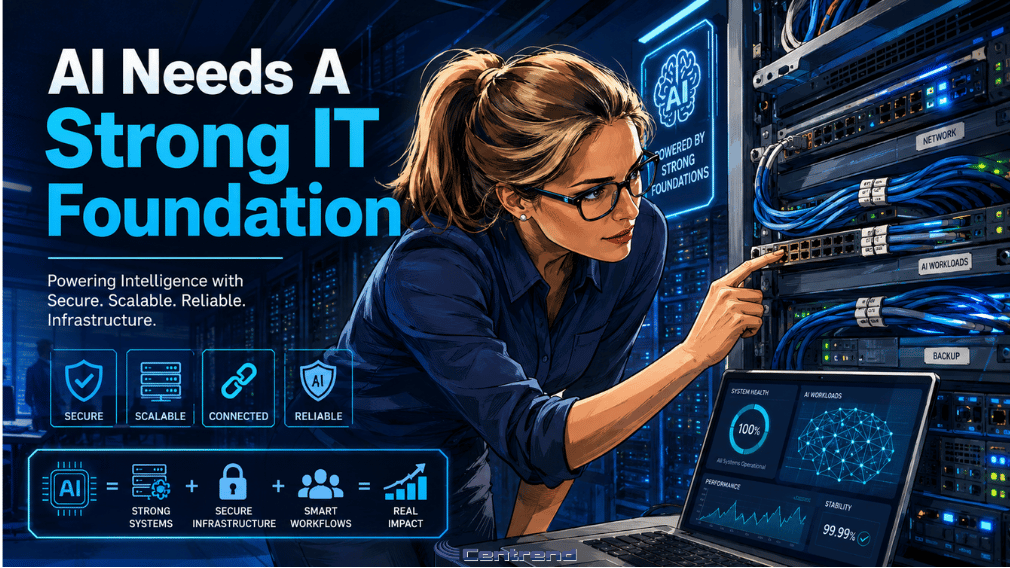
AI Needs A Strong IT Foundation illustration showing an IT professional inspecting server infrastructure, organized network cables, system health dashboards, and secure technology foundations that support reliable AI use.

AI Needs a Strong IT Foundation

AI needs reliable, secure, and connected systems to deliver real business value. Businesses are investing in AI to reduce repetitive work, improve reporting, organize information, and help teams move faster. But when the IT environment is outdated, disconnected, or poorly secured, AI cannot deliver reliable results. It may simply expose the problems that were already there. The problem: AI depends on your existing systems AI does not operate in isolation. It relies on: When those systems do not work well together, AI has less dependable information to use. The result can be: A powerful AI tool cannot compensate for a weak technology foundation. Why this matters Many businesses begin their AI journey by asking: Which tool should we use? The better question is: Is our IT environment ready to support it? A new AI platform may look impressive during a demonstration. But once it needs to connect with an ERP system, customer database, shared drive, email platform, or internal workflow, hidden problems can surface quickly. Outdated software may not integrate properly. Different departments may store conflicting versions of the same information. Employees may rely on manual workarounds that no one has documented. Access permissions may be broader than they should be. Instead of removing work, AI can create another layer for the team to manage. Five signs your IT foundation may not be ready 1. Your systems do not communicate Information may be spread across accounting software, spreadsheets, email, CRM platforms, shared drives, and ERP systems. If employees must repeatedly copy information between tools, AI will likely face the same disconnected process. 2. Your business data is inconsistent AI needs reliable information. Duplicate customer records, outdated documents, incomplete fields, and conflicting reports can weaken the result, even when the AI response sounds confident. 3. Your software is outdated Older applications may lack secure integrations, modern APIs, vendor support, or the performance needed for new AI workflows. Connecting AI to unsupported systems can create technical problems and unnecessary risk. 4. Access control is unclear AI should not automatically have access to every document, customer record, financial file, or employee folder. Permissions must be defined before information is connected to an AI tool. 5. Security gaps already exist Weak passwords, shared accounts, delayed updates, unmanaged devices, and poor monitoring do not disappear when AI is introduced. They become part of the AI risk. AI can amplify existing problems AI is designed to move information and complete tasks faster. That is valuable when the underlying process is clear and secure. But speed can also make weak systems harder to control. AI may retrieve outdated files faster. It may move incorrect information between disconnected platforms. Or give more users access to data that was already poorly protected. It may automate a process that still depends on manual corrections. Before adding AI, businesses should understand what the technology is being connected to. What a strong AI foundation looks like Reliable managed IT Networks, devices, applications, backups, and support systems should be stable enough to handle new workflows without creating disruption. Connected business systems ERP, CRM, accounting, communication, and document platforms should exchange information clearly where integration is required. Organized business data Important records should be accurate, current, and stored in approved locations. Strong cybersecurity controls Access should follow the principle of least privilege, with multifactor authentication, secure devices, updated systems, and appropriate monitoring. Clear workflow ownership The business should know: Technology works better when responsibility is clear. Start with an IT readiness review Before investing in another AI platform, review the environment it will depend on. Ask: These questions can prevent an exciting AI project from becoming an expensive technical problem. Build the foundation before scaling Businesses do not need to modernize everything at once. Start with the systems connected to the first AI use case. Review the workflow. Fix the most important gaps. Secure the access. Test the integration. Measure the result. Then expand only when the environment can support it. The goal is not simply to add AI. The goal is to make AI dependable. The bottom line AI can help businesses work faster, organize information, and reduce repetitive tasks. But it cannot create reliable value from outdated systems, disconnected tools, weak security, or poor data. Before adding AI, strengthen the foundation beneath it. Because smarter technology still needs reliable IT. Build an IT foundation ready for AI Centrend helps businesses evaluate their technology environment, improve system integration, strengthen cybersecurity, and prepare existing workflows for practical AI use. Not sure whether your IT environment is ready for AI? Contact Centrend to identify the gaps, strengthen the foundation, and build a clearer path forward. Ready to turn AI ideas into practical business value? Download the Centrend AI brochure to explore our services, process, safeguards, and approach to responsible AI adoption.

AI Needs a Strong IT Foundation Read More »

Centrend 20th Anniversary: built on client trust, proactive IT, and support that keeps teams secure, productive, and growing. Executive portrait in a modern IT office with “20 Years” sign and subtle balloons.

Centrend 20th Anniversary: Built on Client Trust

Centrend 20th Anniversary Most business owners do not wake up excited to think about IT. You just want your team to log in, get work done, and go home on time. You want files to open fast, email to behave, printers to stay quiet, and security to be something you do not have to lose sleep over. But when technology is reactive, it steals time in the most expensive way possible: interruptions, downtime, surprise bills, and that lingering feeling that you are one click away from a bigger problem. And the truth is, “good enough” IT usually looks fine right up until it does not. A missed patch becomes a ransomware headline. A failing backup becomes a week of reconstruction. A vague support plan becomes finger-pointing when something critical breaks. The cost is not only money. It is momentum. Trust. The confidence to grow. That is exactly why Centrend exists, and why we are proud to celebrate 20 years in business. 20 years of proactive IT, built for real businesses For two decades, Centrend has focused on one simple goal: streamline your technology so you can focus on growing your business. That means we do not wait for things to fail. We design, maintain, protect, and improve your environment so problems get prevented, not “handled later.” Proactive IT is not a buzzword. It is a discipline. It is consistent standards, clear processes, real accountability, and security that is treated like a business requirement, not an add-on. That mindset is also why our communication matters just as much as our tools. We believe in no nerd-words. You deserve straight answers and clear recommendations you can act on. The milestone is ours, but it was built with our clients Anniversaries are not really about the company. They are about the people who trusted the company. To every client who called us during a stressful moment, gave us the chance to prove ourselves, and stayed with us as your business evolved: thank you. You have shaped how we operate, what we prioritize, and the standards we hold ourselves to. You pushed us to be better in the moments that matter most: If Centrend has earned a reputation for being responsive, practical, and security-minded, it is because our clients demanded that level of service, and we chose to meet it. What we stand for, and why it works Over 20 years, the tools have changed. The threats have changed. The expectations have changed. What has not changed is what businesses need from their IT partner. You need prevention, not panic Centrend 20th Anniversary is the benchmark of proactive monitoring, patching, and maintenance are not exciting, but they are what stop the “small issues” from becoming expensive interruptions. You need security you can trust Security is not a product you buy once. It is a system of habits and controls that gets reviewed, updated, and enforced. We take that seriously, including aligning with security-focused programs and best practices as requirements increase. You need support that respects your time When something goes wrong, you should not have to fight for a response or explain your environment from scratch. You deserve fast, reliable help and follow-through. You need a partner who owns the outcome One of our core promises is simple: if you are unhappy with our work, we will do what it takes to make it right to your standards. No small print. The Centrend approach in plain English Here is what “proactive IT” looks like when it is done the right way: In other words: we help make IT boring again. In the best way. Looking ahead: the next 20 years of business IT If the last decade proved anything, it is that change is now constant. Cloud adoption, remote work, vendor sprawl, cyber insurance pressure, compliance expectations, and AI-driven threats are all accelerating. Centrend 20th Anniversary. Our commitment for the future is the same as it has been: keep your systems secure, keep your people productive, and keep your technology aligned with the business. That means doubling down on: Thank you for building this milestone with us Centrend turning 20 is a proud moment. But it is also a reminder that trust is earned over time, ticket by ticket, project by project, and conversation by conversation. To our clients, partners, and community: thank you for 20 years of trust. We do not take it lightly. If you are a long-time client, we are grateful you are here. If you are new to Centrend, we would love the chance to show you what proactive IT support feels like when it is built around your business. Request a proactive IT roadmap for the next 6 to 12 months.

Centrend 20th Anniversary: Built on Client Trust Read More »

Scroll to Top