Centrend

AI workflow automation

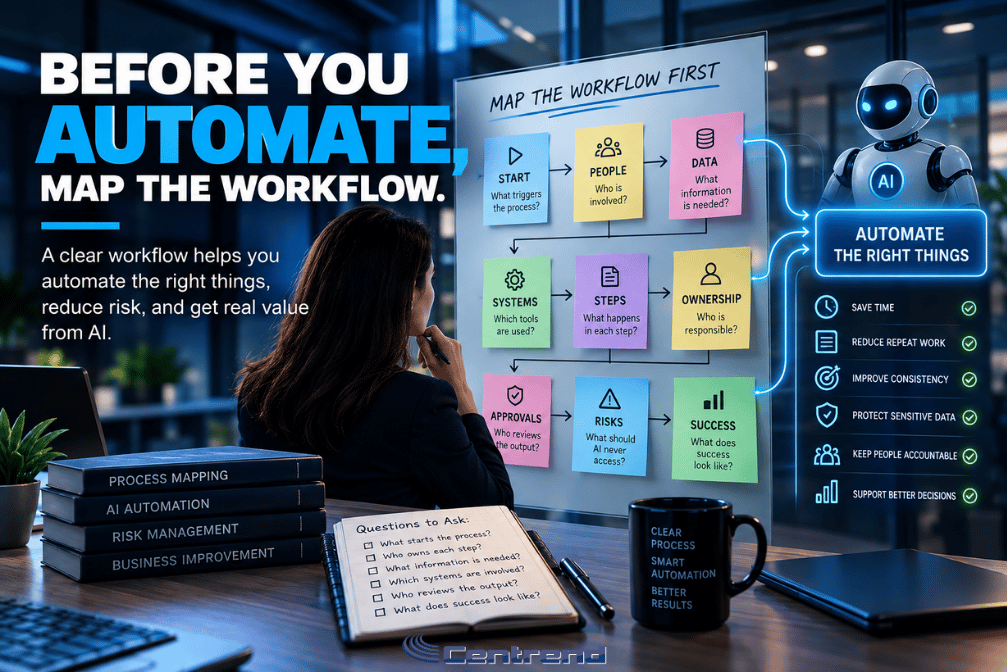
Before You Automate, Map the Workflow

Before You Automate anything, make sure the workflow is clear. That sounds simple. But many businesses skip this step. They see a task that takes too long, choose an AI tool, and try to make it faster. The problem is that speed does not fix confusion. If the process is unclear, automation can make the wrong work happen faster. The problem AI and automation are often treated like shortcuts. A team wants fewer manual tasks. A manager wants faster reports. A business wants quicker replies. A department wants less repeated work. Those are good goals. But if the process behind the work is messy, automation may only repeat the mess. That can create: Automation should not begin with the tool. It should begin with the workflow. Why this matters Every workflow has moving parts. People.Systems.Files.Approvals.Data.Decisions.Review steps. If those parts are not clear, AI may not know what should happen next. The business may not know either. That is where problems start. One person may use the wrong input. Another may skip a review step. Someone else may trust an output that should have been checked. A faster process is only valuable when the process is already right. The better approach Before using AI or automation, map the workflow. Look at how the work happens today. Ask: These questions help reveal whether the task is ready for automation. Sometimes it is. Sometimes the process needs cleanup first. Clear process comes first A clear process helps everyone understand the path from start to finish. It shows what needs to happen, who is responsible, and where delays or confusion appear. Without that clarity, AI may support the wrong step. Or automate work that should still involve a person. The goal is not to automate everything. The goal is to automate the right things. Ownership matters Every automated workflow needs an owner. Someone needs to know: AI can assist the work. It should not own the outcome. Accountability still belongs to people. Approved inputs protect the business AI output is only as good as the information behind it. If the input is outdated, incomplete, or unapproved, the result may look polished but still be wrong. That is why businesses need clear input rules. What files can be used? Which data sources are trusted? What customer or company information should stay out? Which tools are approved? These rules help protect privacy, accuracy, and trust. Review steps keep AI useful Human review is not a delay. It is a safeguard. AI can draft, summarize, organize, and route information. But people still need to confirm the facts, check the tone, protect sensitive details, and make sure the final result fits the business. Review steps help prevent small errors from becoming bigger problems. They also help teams trust the workflow over time. What better automation looks like Good automation should feel controlled. It should reduce work without removing visibility. It should help teams: That only happens when the workflow is mapped first. How Centrend helps Centrend helps businesses look at the workflow before choosing the tool. That means identifying the real problem, clarifying ownership, reviewing inputs, adding guardrails, and defining where human review belongs. The goal is practical automation. Not more confusion. Nor more disconnected tools. Not faster errors. Just clearer workflows that help the business move with more confidence. TL;DR Automate the right way Before your business tries to speed up a process, make sure the process is ready. A clear workflow helps AI and automation create real value without adding confusion, risk, or extra review work. Talk to Centrend about mapping your workflow before you automate.

Before You Automate, Map the Workflow Read More »
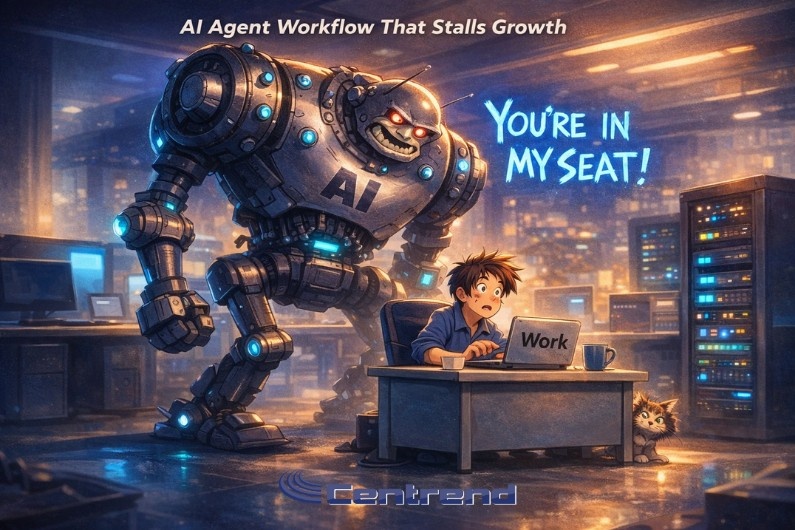
AI Agent workflow scene showing a giant AI robot looming over a surprised office worker at a desk, with the text “You’re in my seat!” and a warning theme about stalled growth.

AI Agent Workflow That Stalls Growth

AI Agent Workflow Most teams do not lose momentum because of bad ideas.They lose momentum in the handoff between one AI step and the next. A lead comes in.One agent qualifies it.Outreach drafting comes next.Urgency scoring follows.CRM updates close the loop. Everything looks fast on paper.But one missing rule, one unclear trigger, or one skipped check can freeze the whole chain. Not with an error that screams.With silence. That is where teams are testing agentic AI workflows right now:not only for speed, but for control, trust, and decision flow. What teams are testing now 1) Clear decision lanes per agent Teams are assigning each agent a very narrow role: When one agent tries to do too much, outputs become mixed and hard to trust.Focused roles create cleaner handoffs and faster decisions. 2) Guardrail checks between every handoff Instead of checking only at the end, teams are placing small checks in the middle: These micro-checks prevent bad outputs from moving downstream. 3) Confidence-based routing If confidence is high, the workflow continues.If confidence is low, it routes to a person. This keeps work moving without forcing humans into every step. 4) Fallback logic for edge cases Strong teams are planning for exceptions: Without fallback rules, one edge case can hold up ten clean tasks behind it. 5) Audit-friendly logs Teams want to answer one question fast:“Why did the AI choose this?” They are logging: That makes reviews faster and cuts repeat mistakes. Where small guardrail gaps block decisions Small gaps rarely look dangerous in isolation.But in multi-agent flow, they stack. A weak prompt instruction becomes a wrong category.A wrong category becomes a wrong priority.A wrong priority delays a critical follow-up.The delay becomes lost revenue or missed timing. By the time someone sees the impact, the root cause is hidden three steps earlier. That is why leading teams are not only asking,“Can this workflow run?”They are asking,“Can this workflow stay reliable under pressure?” A practical structure teams are using Use this sequence to keep decisions fast and safe: This structure keeps speed without losing judgment. What this means for teams now The next advantage is not just “using AI agents.”It is building decision-safe agent workflows. Fast is easy to demo.Reliable is what scales. AI Agent Workflow is when teams close small guardrail gaps early, they stop invisible delays before they spread.Decisions move with more clarity.People trust the system sooner.And execution becomes consistent, not chaotic. One weak handoff can stall the whole pipeline. Let’s fix it. Book a Call!

AI Agent Workflow That Stalls Growth Read More »

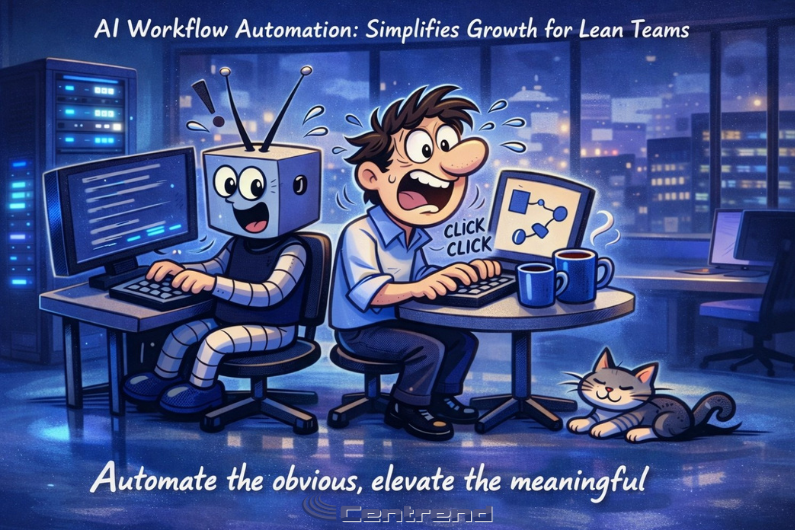
AI Workflow automation illustration showing a robot and a human working side by side in a blue-lit digital office, with glowing screens, server racks, and a resting cat, highlighting fast task execution and team support.

AI Workflow Automation Simplifies Growth for Lean Teams

AI workflow automation, lean teams do not fail because they lack ideas.They fail because too much time goes to repetitive work, slow approvals, and disconnected tools. You start the week with a clear plan. By Friday, you are buried in manual tasks, chasing updates, and rewriting the same message for different channels. Output drops. Quality slips. Growth stalls. That is the real problem. The good news is this: you do not need a big team to scale. You need a smarter workflow. AI workflow automation helps lean teams remove bottlenecks, speed up execution, and focus on the work that actually drives results. The real pain lean teams face Most lean teams deal with the same pressure points: When this repeats every week, growth becomes reactive instead of intentional. Why the old way stops working The old workflow depends on constant human effort for every small step: This model does not scale. It burns people out and makes performance inconsistent. The better path: AI workflow automation AI workflow automation is not about replacing your team.It is about removing repetitive friction so your team can do higher-value work. A practical setup looks like this: That is how lean teams create consistency without adding headcount. What changes after implementation When the workflow is structured correctly, you will see clear improvements: The key shift is simple: stop measuring activity, start measuring outcomes. Not just opens.Clicks, conversions, and pipeline impact. A simple rollout for lean teams You do not need a huge launch. Start small and build confidence. Small consistent steps create scalable systems. Final takeaway Lean teams grow faster when they stop doing everything manually.AI workflow automation gives structure, speed, and focus, so you can produce better marketing with less strain and stronger results. If growth matters, simplify the workflow first.Everything else gets easier after that. Turn cybersecurity tips into real results, Schedule a Strategy Call Today!

AI Workflow Automation Simplifies Growth for Lean Teams Read More »

Scroll to Top