Centrend

AI security

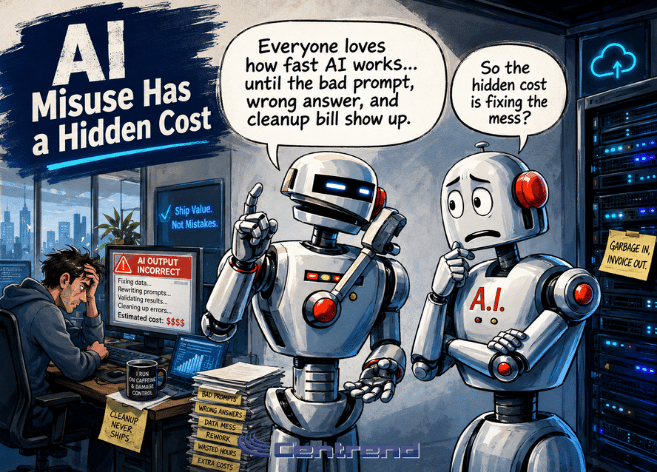
AI Misuse Has a Hidden Cost editorial cartoon showing AI-themed office characters in a modern tech setting, highlighting the risks of careless AI use.

AI Misuse Has a Hidden Cost

AI Misuse is not always obvious at first. It may look like a faster email. A quicker report. A cleaner summary. A tool that helps someone get through work faster. But when AI is used without rules, review, or clear direction, the hidden cost can show up later. The wrong answer. Private information that should not have been shared. A the customer reply that sounds polished but inaccurate. In the report that looks finished but was never checked. AI can save time. But misused AI can quietly create more work, more risk, and more confusion. Why this matters AI is already being used inside many businesses, even when there is no official process in place. Employees may be testing tools on their own. They may use AI to write emails, summarize documents, research topics, or organize ideas. That is not always a problem. The problem starts when no one knows what is allowed, what is risky, or what needs to be reviewed before it is used. That is where AI misuse begins. Not with bad intentions. Often, it starts with someone trying to save time. The hidden cost of random AI use Random AI use can feel harmless. One employee tries one tool. Another uses a different one. Someone pastes business information into a public AI platform. Someone else sends an AI-written message without checking the details. Over time, this creates problems that are easy to miss. • Inconsistent communication• Incorrect information• Privacy concerns• Unclear responsibility• Extra review work• Off-brand messaging• Poor customer experience• Security and compliance risks The business may think AI is helping. But behind the scenes, it may be creating new gaps. The problem is not AI AI is not the problem by itself. The real issue is using AI without a plan. Without clear rules, AI becomes another tool people use in different ways, with different standards, and different levels of review. That creates confusion. It also makes it harder for the business to know what information was used, where it went, who checked it, and whether the final result is accurate. AI should support the work. It should not make the work harder to trust. What AI misuse can look like AI misuse does not always look dramatic. It can look simple. A team member asks AI to rewrite a customer message and sends it without reviewing the details. A manager uses AI to summarize a document that includes sensitive information. An employee uses a free tool because it is easy, even though the business has not approved it. A report is created quickly, but the numbers or facts are not verified. A reply sounds professional, but it does not match the company’s tone or promise. These small moments matter. One small mistake can create a bigger issue for the business. The cost is more than time When AI is misused, the cost is not just wasted time. It can affect trust. Customers may receive wrong or unclear information. Employees may rely on answers that were never checked. Sensitive data may be shared in places it should not be. Leadership may think a process is under control when it is not. The hidden cost is the loss of confidence in the work. Once that trust is damaged, fixing it takes more time than the AI saved in the first place. How businesses can use AI more safely The answer is not to avoid AI completely. The better answer is to use AI with clear direction. Businesses should define where AI can help, where it should not be used, and what must be reviewed before anything becomes final. A safer AI process should include: • Approved AI tools• Clear use cases• Rules for sensitive data• Human review steps• Brand and tone guidance• Accuracy checks• Ownership of the final output AI should help create a first draft, organize information, or support a workflow. But people should stay responsible for the final decision. Start with the right questions Before using AI across the business, start with simple questions. What tasks are safe for AI to support? What information should never be entered into AI tools? Who reviews the output? What tools are approved? What type of work still needs human judgment? How do we make sure AI sounds like our business? These questions help turn AI from a random tool into a safer business process. The better way forward AI works best when it has structure. That means starting with practical use cases, setting rules, reviewing outputs, and keeping people involved. The goal is not to use AI everywhere. The goal is to use AI where it can safely reduce friction, save time, and support better work. When AI is guided by the right process, it becomes more useful. When it is used randomly, it becomes harder to control. The bottom line AI misuse has a hidden cost. It can create confusion, expose sensitive information, weaken customer trust, and add more review work for your team. The businesses that get the most value from AI will not be the ones that use it the fastest. They will be the ones that use it with the most clarity. AI should not replace judgment. It should support better work with the right guardrails, review, and process in place. Use AI with more clarity and less risk. Centrend can help your business identify practical AI use cases, set safer rules, and build workflows that support your team without creating more confusion. Not sure where AI fits? Contact Centrend to turn AI misuse into one clear, practical next step.

AI Misuse Has a Hidden Cost Read More »

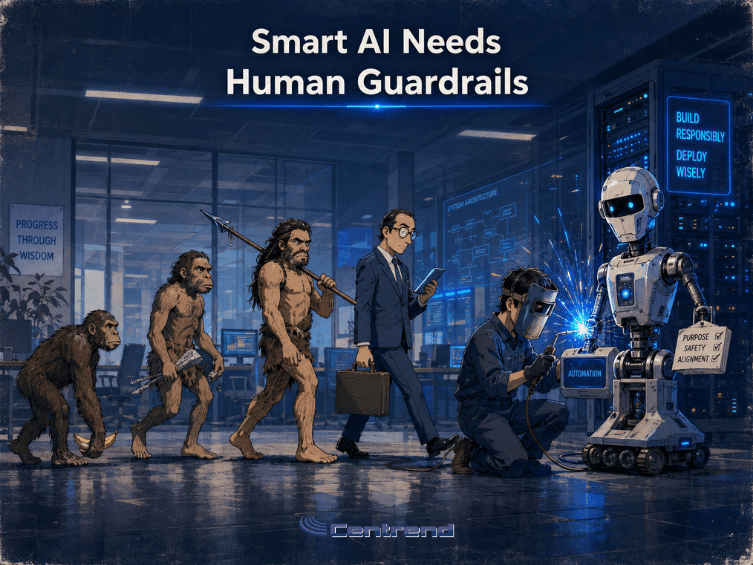
Smart AI Needs Human Guardrails illustration showing the evolution from early humans to a modern worker and a robot in a blue-toned IT office with servers and human oversight.

Smart AI Needs Human Guardrails

Smart AI use starts with one simple rule: it should not run without human guardrails. Businesses are using it to draft emails, summarize notes, organize ideas, support customer communication, and speed up daily work. That can save time, but it also creates one important question: Who is checking what it produces? Without clear rules, teams can accidentally expose sensitive information, trust incorrect answers, or use content that does not match the company’s standards. That is where risk begins. Why this matters AI can sound confident even when it is wrong. A polished answer is not always accurate. A fast draft is not always safe. A helpful summary may still miss important details. For businesses, this matters because one careless use can affect customers, internal decisions, data privacy, and trust. The goal is not to avoid AI. The goal is to use it with security, accuracy, and human review. 1. Protect sensitive data Not everything belongs in an AI tool. Teams should avoid entering customer information, passwords, financial details, private company documents, HR information, legal content, or anything confidential. A simple rule helps: If it should not be public, do not paste it into a public tool. 2. Check every important answer AI-generated content should never be accepted automatically. It can be incomplete, outdated, or simply wrong. Before using the output, your team should check facts, confirm details, and review anything that could affect a customer, project, report, or business decision. Fast is helpful. Correct is essential. 3. Keep people in control AI should support your team, not replace judgment. People still need to decide what is accurate, appropriate, useful, and aligned with the business. This matters most for customer replies, marketing content, reports, policies, and anything connected to your reputation. Human review is not extra work. It is the safety step. 4. Set clear rules for the team A safer AI process should be simple enough for everyone to follow. Your business should define: What AI can be used forWhat information should never be enteredWhich tools are approvedWho reviews the final outputWhen approval is required Clear rules reduce confusion and help teams use AI more consistently. 5. Make AI fit your business AI works better when it is built around your actual workflow. That means it should support your brand voice, customer response process, internal standards, and team responsibilities. The real value is not just using AI. The real value is using it in a way that fits how your business works. The bottom line AI can help businesses move faster. But speed without control creates risk. The smart approach is simple: Protect sensitive data.Check the output.Keep people involved.Set clear rules.Use approved tools. With the right guardrails, AI can help your team work with more confidence, better accuracy, and stronger protection. Use AI with confidence, not guesswork. Centrend can help your business create safer AI workflows, protect sensitive information, and build smarter technology processes that support the way your team works. Talk to Centrend About Safer AI Use

Smart AI Needs Human Guardrails Read More »

Scroll to Top