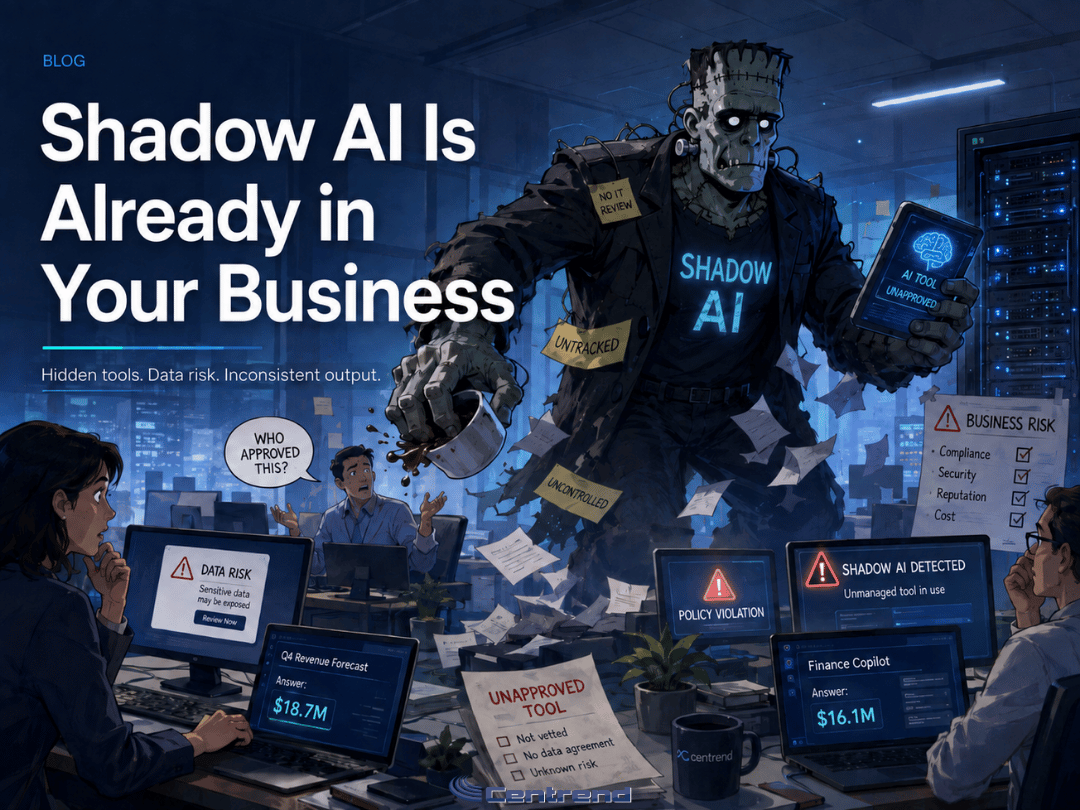
Shadow AI is what happens when employees use AI tools without approval, guidance, or clear oversight.
It may already be happening in your business.
Someone may use AI to write an email.
Summarize a meeting.
Draft a report.
Review a file.
Answer a customer question.
That can feel helpful at first.
But without clear rules, hidden AI use can create real business risk.
The problem
AI is easy to access.
That is why employees may start using it before the business has a policy, approved tools, or a clear review process.
The issue is not always bad intent.
Most employees are trying to save time.
But if they enter customer data, company files, financial details, HR information, or private business content into the wrong tool, your business may lose control of where that information goes.
That is the risk of Shadow AI.
It happens quietly.
And it can grow quickly.
Why this matters
Hidden AI use creates hidden risk.
When different employees use different AI tools, your business may not know:
- What tools are being used
- What information is being entered
- Who is reviewing the output
- Whether customer data is protected
- Whether the answer is accurate
- Whether the message matches your company standards
That creates more than a technology issue.
It creates a trust issue.
A polished AI response can still be wrong.
A fast summary can still miss important context.
A helpful draft can still expose sensitive information.
Speed is useful.
But speed without oversight can create bigger problems.
Where Shadow AI shows up
Shadow AI often starts in everyday work.
It may appear in:
- Customer emails
- Internal reports
- Meeting notes
- Sales drafts
- HR messages
- Research summaries
- Spreadsheet explanations
- Policy drafts
- Vendor communication
- Marketing content
These tasks may seem simple.
But many of them involve business information that should be handled carefully.
That is why AI use needs structure.
What can go wrong
When AI use is unmanaged, small mistakes can become business problems.
Your team may create:
- Inconsistent customer replies
- Inaccurate reports
- Exposed private information
- Off-brand messaging
- Unchecked recommendations
- Duplicate tools across departments
- Confusing workflows
- Extra review work
- Security and compliance concerns
The business may think AI is saving time.
But if the output needs to be corrected, checked, rewritten, or investigated later, the savings can disappear quickly.
The better approach
The answer is not to ignore AI.
The answer is to bring AI use into the open.
Businesses need clear rules that help employees understand where AI is helpful, where it is risky, and what information should never be entered into public tools.
A safer AI approach should include:
- Approved AI tools
- Clear employee usage rules
- Data protection guidelines
- Human review steps
- Defined use cases
- Output approval standards
- Access controls
- Accountability for final work
AI should support the team.
It should not operate in the background without visibility.
What employees need to know
A good AI policy should be simple enough for employees to follow.
It should answer practical questions:
- Which AI tools are approved?
- What tasks can AI help with?
- What information should never be entered?
- Who reviews the final output?
- What work should stay outside AI?
- Who should employees ask when unsure?
Clear rules reduce confusion.
They also help employees use AI more confidently and responsibly.
Why oversight matters
AI oversight is not about slowing people down.
It is about protecting the business while still allowing useful innovation.
Oversight helps make sure AI use is:
- Secure
- Accurate
- Consistent
- Reviewed
- Aligned with company standards
- Connected to real business goals
Without oversight, AI becomes scattered.
With oversight, AI becomes more practical.
The bottom line
Shadow AI may already be inside your business.
Not because employees are trying to create risk.
But because AI is easy to use, and many teams do not yet have clear rules.
The longer hidden AI use goes unmanaged, the harder it becomes to control.
Your business does not need to use AI everywhere.
It needs to use AI clearly, safely, and with the right oversight.
Bring AI use into the open
Centrend AI helps businesses review AI use, identify hidden risks, create clear employee rules, and build safer workflows around approved tools.
Not sure where AI is already being used in your business? Contact Centrend AI to review your AI risks, set clear guardrails, and create a safer path forward.