Centrend

CMMC Level 2

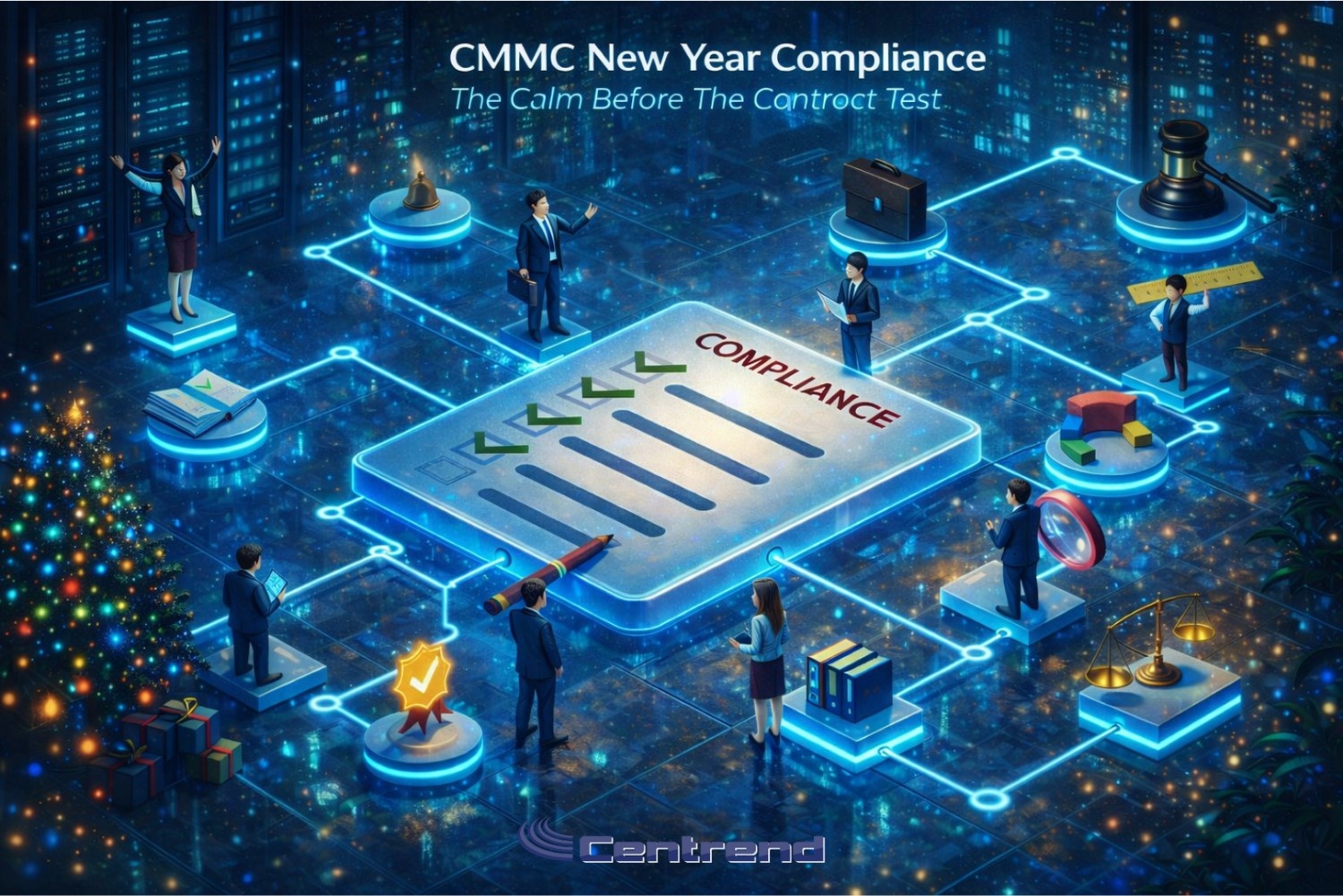
CMMC New Year Compliance graphic showing a digital checklist and contract icons connected in a blue network style scene

CMMC New Year Compliance: The Calm Before The Contract Test

CMMC New Year Compliance January feels quiet. Fewer meetings. A lighter inbox. People easing back in. But defense work does not wait for a clean start. This is the week when primes ask for proof, contracting teams tighten requirements, and your next bid can hinge on one simple question: Can you show your CMMC posture clearly, quickly, and in writing? If your answer is “we’re close” or “our IT vendor said we’re covered,” New Year is when that gap turns into a scramble. The scramble usually looks like this: Your team is chasing screenshots and policiesSomeone realizes SPRS is missing a required postRemote access is messy after holiday travelA single outage or login issue slows work and pushes people into risky workarounds And suddenly the “slow” week becomes the most expensive week of the quarter. What “New Year compliance” actually means in CMMC terms CMMC New Year compliance is not a slogan. It is your ability to start the year with: A clear scope of what systems touch CUI and FCIThe right version of the standard applied the right wayEvidence that matches what an assessor or prime will ask forRemote access that stays secure even when people are travelingResilience when a cloud provider, DNS, VPN, or identity service has a bad day If you want a practical target, aim for this: If someone asked you today for your CMMC Level 2 story, you could share it in one email thread without backtracking. The most common New Year mistake: following the wrong “version” A lot of teams hear “Rev 3 is here” and panic. Here is the clarity that matters: CMMC Level 2 is based on NIST SP 800-171 Revision 2 for assessment and scoring today.NIST SP 800-171 Revision 3 exists and is final, but it is not what CMMC Level 2 is scored against right now. So the smart move is not “switch everything to Rev 3 overnight.”The smart move is: Get clean on Rev 2 now, and build a controlled plan to absorb Rev 3 changes without blowing up your program. NIST SP 800-171 Rev 3 was published as final on May 14, 2024. The requirement that trips teams up: SPRS and award readiness CMMC New year Compliance is where New Year gets real. Because even if your internal controls are improving, award workflows often depend on what is posted and affirmed. In DoD’s DFARS ecosystem: DFARS 252.204-7025 requires offerors to post the results of a CMMC Level 1 or Level 2 self assessment to SPRS prior to contract award, and identify the information systems that will process, store, or transmit FCI or CUI. That is not a “later” task. That is a before-award reality in the flow DoD describes. If you want one New Year action that reduces stress fast, do this first: Confirm what is posted in SPRS, confirm it matches your scoped systems, and confirm the affirming official process is understood. The hidden cost of “we’ll handle it later” When teams postpone these checks, the damage usually shows up as: Bid delays because someone cannot verify compliance statusLast minute policy writing that does not match the environmentOver-permissioned remote access because it is easier in the momentUntracked tools used during downtime because people just need to workEvidence gaps that create uncomfortable conversations with primes It is rarely one big failure.It is ten small gaps that collide when the year starts moving fast. The New Year CMMC compliance reset A practical 90 day path that does not overwhelm your team Here is a clean way to run this without chaos. 1) Lock scope before you “fix” anything Write down, in plain terms: Which people, devices, and systems touch CUIWhich systems are in scope for CMMC Level 2Where CUI lives, moves, and is sharedWhich vendors and SaaS tools are part of that path If scope is fuzzy, your controls and your evidence will be fuzzy too. 2) Make Rev 2 your audited baseline Because CMMC Level 2 aligns to NIST SP 800-171 Rev 2 for scoring today, your January goal is: A complete Rev 2 control map with ownersEvidence tied to each controlA living POA and M plan that is realistic, dated, and owned This is how you avoid “paper compliance” that breaks under real questions. 3) Confirm SPRS readiness before bids heat up Treat SPRS like a New Year gate, not a back-office chore. Verify your posting status and documentation path for CMMC Level 1 or Level 2 self assessment results as described in DFARS workflows. Also confirm your internal list of systems matches what you will identify in award workflows. 4) Harden remote access for the “travel month” reality New Year includes travel, hybrid schedules, and “I’m logging in from somewhere else.” Focus on: Multi factor authentication everywhere it mattersLeast privilege access that matches job rolesDevice checks for managed vs unmanaged endpointsClear offboarding and access review routines This is where a lot of “cheap IT” quietly creates long term risk. 5) Build cloud resilience so outages do not become security incidents Outages happen. The goal is not perfection. The goal is continuity without risky improvisation. Document: Your backup path for DNS and critical servicesWho flips what switch during an outageWhat your team uses if VPN or identity is unstableHow you log and retain incident notes for audit trails When the plan is clear, people do not panic click. 6) Start a calm Rev 3 transition plan Rev 3 is real and it is worth preparing for. But do it like adults: Create a delta list between Rev 2 and Rev 3Prioritize changes that improve security now anywaySchedule updates around business cycles and contract prioritiesAvoid rewrites that erase working evidence You are not starting over. You are maturing. A simple way to measure if you are ready Ask yourself: If a prime requested our CMMC Level 2 posture this week, could we respond in one business day with confidence? If the answer is “maybe,” your New Year task is not more tools.It is clarity, scope, evidence, and

CMMC New Year Compliance: The Calm Before The Contract Test Read More »

Centrend graphic showing NIST SP 800-171 Revision 3 vs CMMC certification in a modern IT office, highlighting updated security requirements, aligning with NIST, and new assessment procedures.

CMMC Level 2 vs NIST 800-171 Rev 3: Contractor Essentials

CMMC Level 2. You keep hearing two messages at once: At the same time, the CMMC final rule is in place and showing up in real solicitations with award and assessment requirements for Level 2. No surprise that many defense contractors are asking a simple but urgent question: “Are we supposed to follow NIST 800-171 Rev 2 or Rev 3 for CMMC Level 2 right now?” If you guess wrong, you can end up with gaps in the version that assessors actually use, which can hurt both your SPRS score and your CMMC award eligibility. This post gives you a clear answer and a practical way forward. The confusion: two versions, one set of contracts Here is the situation in plain language: Recent articles aimed at defense contractors spell it out: So right away you can see the split: That is the source of the headache. What NIST 800-171 Rev 3 really changed NIST did not scrap Rev 2. It cleaned it up. Key points from NIST and expert explainers: DoD has also published Organization Defined Parameters (ODPs) for Rev 3 controls. These give concrete values for things like log retention, lockout thresholds, and other “tunable” settings in the new version. In other words, Rev 3 is the direction of travel for federal CUI protection, and DoD is already shaping how it will be used. But that still does not mean it is the CMMC Level 2 scoring baseline today. What CMMC Level 2 really checks today The CMMC final rule and most public mappings are still clear: Current guidance for contractors and MSPs still says: So if a C3PAO comes in to do a Level 2 assessment on a CMMC tagged contract: This is the part that “defense contractors must follow right now” for contract and award purposes. What defense contractors must follow right now Putting it together: So the practical answer: Right now, if you want to pass CMMC Level 2 and protect your DoD contract eligibility, you must be able to show a solid, evidence backed implementation of NIST 800-171 Rev 2 across your in scope systems. Rev 3 is “next”, not “instead of” Rev 2. How to use Rev 3 without breaking your CMMC audit You do not have to choose Rev 2 or Rev 3. The smart move is to use both in a controlled way. Step 1 – Lock in Rev 2 as your scored baseline This is the version that controls your SPRS score, DFARS 7012/7020/7021 posture, and CMMC assessment results today. Step 2 – Build a simple Rev 3 “overlay” instead of a rewrite For Rev 3: Then add a short overlay column to your internal tracking: This lets you prepare for the shift without throwing away the Rev 2 structure that CMMC Level 2 still uses. Step 3 – Use DoD’s ODP memo to tune settings, not to change your baseline DoD’s April 2025 memo sets Organization Defined Parameters for Rev 3. That gives you clear numbers for things like: You can borrow those values to sharpen your own settings even while your audit baseline is still Rev 2. This is a safe way to “future proof” your environment without stepping outside CMMC’s current scoring model. What this means for your next 12 months In the next year, most defense contractors will juggle three things at once: A simple way to talk about this with leadership: That is a very different message than “we have to start over for Rev 3.” Turning version confusion into a CMMC strength CMMC, NIST 800-171, and DFARS are not going to get simpler on their own. But this part can be clear: The contractors who stay ahead will be able to say: That is a strong, calm story to bring into both capture meetings and assessments. How Centrend can help your team right now Centrend can help defense contractors: If you want a focused working session, we can walk your team through a short Rev 2 vs Rev 3 CMMC Readiness Review and leave you with a practical action list for the next 90 days. Learn more about how Centrend’s Cybersecurity Services help defense contractors stay secure and CMMC ready.

CMMC Level 2 vs NIST 800-171 Rev 3: Contractor Essentials Read More »

CMMC holiday cybersecurity readiness graphic with a Christmas tree, data center, and two defense contractors reviewing a laptop.

CMMC Holiday Cybersecurity Readiness for Defense Contractors

CMMC Holiday Cybersecurity Readiness. The holiday season is when your team slows down. Attackers see that as an open door. Government alerts and real incidents show the pattern: ransomware and major cyber events often hit on holidays and weekends, when staff is thin and response is slower. This year, that risk lines up with the CMMC final rule and new DFARS clauses showing up in real DoD awards. CMMC is now live in select contracts, and any gap can hit you twice: it hurts your eligibility and it increases the damage if an incident lands during a busy season. So the question is simple: if a serious cyber event hit on a holiday, would your CMMC story hold up under real pressure? This post gives you a clear way to test that before the next long weekend. Why holidays are a stress test for your CMMC program For most defense contractors, the holiday pattern looks like this: Threat actors know this. CISA and other groups have warned that attacks during holidays and weekends are often slower to detect, take longer to contain, and cause more damage.  From a CMMC view, this hits the same control families you already have to meet: These come straight from NIST SP 800-171, which CMMC Level 2 is built on. A holiday incident is not only about stopping the attack. It is also about whether your controls still work when people are out and whether you can prove that to an assessor or contracting officer later. The holiday risk that CMMC does not forgive CMMC Holiday Cybersecurity Readiness. Now layer in where CMMC is today. The final rule and the DFARS “clause rule” are in effect, with a phased rollout into new contracts. Key points that matter for the holidays: If that 180 day window runs through Thanksgiving, Christmas, New Year, and the usual vacation stretch, you cannot afford to “take a break” from your plan. The clock does not stop because your team is on holiday. A holiday lens on your CMMC controls Here is a simple way to look at your CMMC program through a holiday lens. Treat each section as a short talk with your IT, security, and contracts leads. 1. Who is watching when most people are out? Link to controls: Incident Response, Audit and Accountability Ask: CISA and many surveys show that even a small delay in seeing and handling a holiday attack can multiply the damage. Your holiday coverage plan should not live only in one person’s head. 2. Can people reach CUI systems safely from where they actually are? Link to controls: Access Control, Identification and Authentication, System and Communications Protection During holidays, people work from: Check: CMMC Level 2 expects you to manage who connects, from where, and how traffic is protected.  If your rules are strict on paper but ignored during busy periods, that gap will show. 3. If ransomware hit on a holiday, how would recovery really go? Link to controls: Contingency Planning, System and Information Integrity, Media Protection Ransomware during a holiday is one of the scariest cases. Government advisories highlight that many organizations take longer to respond and recover if the incident starts when key staff is away. Ask: CMMC and NIST 800-171 both expect working backup and recovery, not just a line in a plan.  4. Does your conditional status or POA&M plan survive the holiday calendar? If you are relying on Conditional CMMC Status for Level 2 or 3, your holiday planning is not just about risk. It is also about deadlines. By rule, conditional status: After that, you risk losing that status.  Holiday view: If the calendar looks tight, move work earlier in the season, not later. 5. Will your logs and evidence tell a clear story after the holidays? A holiday incident often becomes a test case. Assessors, primes, or the government may ask what happened, how you responded, and how your plan lined up with your policies and SSP. Tie this back to: Good questions: NIST 800-171 and CMMC Level 2 expect not only technical controls but also documentation and traceability. A short holiday CMMC readiness plan You do not need a huge project before the next break. Even a focused plan over a few weeks helps a lot in CMMC Holiday Cybersecurity Readiness. 1st Week Review and map 2nd Week Fix fast gaps 3rd Week Align evidence and status 4th Week Run a small holiday drill By the end of this short plan, you have something powerful: You can show that your CMMC program still works when staff is thin, when people are remote, and when attackers are most likely to try their luck. Turning holiday risk into a strength in your CMMC story CMMC Holiday Cybersecurity Readiness is not only about passing an audit. It is about showing that your team can protect FCI and CUI in real conditions, including during the busy, distracted, and under staffed weeks of the year.  Holiday cyber events are a harsh test. They stress: Defense contractors that will feel confident in the next wave of CMMC contracts will be able to say: How Centrend can help your team before the next holiday If you want help turning these ideas into action, Centrend can: A short working session now can save you from a long and painful incident later, and it gives you stronger evidence for your next CMMC assessment and DoD bid. Book Your CMMC Holiday Cyber Readiness Call Today

CMMC Holiday Cybersecurity Readiness for Defense Contractors Read More »

DFARS 252.204-7025: CMMC Award Eligibility Checklist

DFARS 252.204-7025 is titled “Notice of Cybersecurity Maturity Model Certification Level Requirements”. It is a solicitation provision, not a contract clause. It appears when the government adds DFARS 252.204-7021 to the resulting contract.In plain terms, 7025: If those items are not current and correct, the government cannot legally award the contract to you. Your CMMC award eligibility checklist for DFARS 252.204-7025 Use this checklist before you commit to a CMMC related bid. Treat it like a short pre-bid gate review. 1. Read the exact CMMC level in the solicitation In the 7025 provision, the contracting officer fills in one required level:  First step: confirm that your current or planned CMMC status actually matches that level for the systems you will use on this contract. Quick check 2. Map the bid to in scope systems, not just your company CMMC and 7025 do not care about your company in general. They care about the specific systems that will process, store, or transmit FCI or CUI for this contract.  For each bid: If you are a prime, include major subs that will handle CUI. DFARS 252.204-7021 and the final rule expect subcontractors to have their own status and entries in SPRS, even though you cannot see their scores directly.  3. Verify your CMMC status in SPRS Next, move from paper to the real system the government checks: SPRS. For each in scope system, confirm that: If you went through a third party assessment, confirm that the C3PAO completed the process and that the record shows as final, not just “in progress”. 4. Confirm your annual affirmation is up to date The rule introduces an “affirming official” who must make an annual affirmation in SPRS that you are meeting your CMMC requirements. The term replaces older “senior company official” language, but the intent is the same.  Ask three simple questions: If the affirmation is older than one year on the date of award or covers the wrong scope, your eligibility is at risk even if the CMMC status itself is still within the three year window.  5. Handle conditional CMMC status and POA&M deadlines Under the final rule, you can be awarded a contract based on a conditional CMMC status if certain gaps are documented in a POA&M. You then have 180 days to close those items and reach full status.  For each contract you are bidding: This is a good place to pull in lessons from your outage or drill work. If patch cycles, vendor upgrades, or network changes are slow during peak periods, plan those POA&M items earlier in the year. 6. Check your subs early Many contractors are surprised when a strong proposal fails because a critical subcontractor is not ready. For any sub that will process FCI or CUI for this contract:  You will not see their SPRS details, but you can still make “award readiness” part of your partner selection and capture process. 7. Align your story: SSP, boundary, and bid language DFARS 252.204-7025 is short, but it hooks into a larger story that includes your: Make sure the way you describe your environment and controls in the proposal matches what sits in SPRS and in your SSP. Misalignment here can lead to tense questions in negotiations or during later assessments. If you recently walked through outage drills, Cloudflare style resilience checks, or tabletop exercises, pull those notes into your evidence set. They support the idea that your security program is real, tested, and tied to your policies. A 30 day CMMC award readiness sprint If you want a simple path between now and your next CMMC related bid, use this short sprint. 1st Week: Get clear on your current state 2nd Week: Fix obvious blockers 3rd Week: Clean up SPRS and affirmations 4th Week: Bake eligibility checks into your capture process By the end of this sprint, your team can answer a simple but powerful question before every proposal: “If the contracting officer checked DFARS 252.204-7025 and SPRS right now, would we be clearly eligible for award” How Centrend can help your team move faster CMMC and DFARS 252.204-7025 are not just more paperwork. They are now part of the basic gate that decides who can win and who never makes it to evaluation. Centrend can help your team: If you want a quick outside view of where you stand, Centrend can lead a short DFARS 252.204-7025 Award Readiness Assesment Call so your next CMMC bid starts from a stronger position.

DFARS 252.204-7025: CMMC Award Eligibility Checklist Read More »

CMMC Level 2 Certification Guide hero with engineer on laptop, audit badge, and document in a server room, Centrend

CMMC Level 2 Certification Guide: Be Audit Ready

CMMC Level 2 Certification award checks are here. The next step is Level 2 certification that holds up under review. This guide gives leaders a clear path scope, evidence, SPRS, and C3PAO readiness without busywork. Status is recorded in SPRS. Many solicitations will require a C3PAO certification as the rollout advances.  What Decision Makers Need to Know Now What Level 2 Really Means Level 2 is proof that controls are implemented and working, not just written. To be taken seriously at award and through performance, you will need: A Simple Plan Leaders Can Run First 30 daysIdentify where CUI resides. Record people, apps, devices, vendors. Baseline against NIST 800-171 and collect existing artifacts.  Days 31 to 60Post your self-assessment in SPRS. Add the required details and complete the affirmation. Prioritize fixes for access control, MFA, logging, backups, incident response.  Days 61 to 90Run a short audit rehearsal. Hold brief interviews, walk through artifacts, confirm subcontractor alignment. If required, reserve a C3PAO window.  Evidence Assessors Ask For First (These align to the families and assessment approach of NIST SP 800-171 and its companion assessment guidance.)  Pitfalls That Stall Awards Prime and Sub Alignment Level requirements flow down. Primes must verify that subs have the correct status in SPRS at the same level. Build a light check: collect each sub’s CAGE, level, score date, and affirmation.  How Centrend Helps Next step: Get CMMC Level 2 Cert Ready! Book a short CMMC Level 2 Certification readiness review. Leave with a plan your team can start this week. Meet with a Centrend readiness lead. We map your scope, set your next three steps, and outline timing and effort. [Book Your CMMC Level 2 Readiness Call]

CMMC Level 2 Certification Guide: Be Audit Ready Read More »

CMMC Enforcement Nov 10 blog hero showing a compliance checklist and DoD contract award board with approved stamp

CMMC Enforcement Nov 10: Are You Award-Ready?

CMMC Enforcement Nov 10, the Department of Defense (DoD) can enforce CMMC at the time of award or extension. If your self-assessment is missing or your SPRS status is wrong you risk getting ruled out before you’re even considered. And the rule is final. The clock is ticking. And if you’re not tracking what’s changing, your pipeline could dry up faster than you think. Why This Matters Now Your eligibility isn’t just about pricing or past performance anymore. Contracting officers will now check your SPRS entry before award. And if you’re not showing a valid Level 1 or 2 self-assessment?You may never make it past evaluation. What’s Changing with CMMC – Final Rule Effective Nov 10– CMMC UID assigned in SPRS to each system that handles FCI or CUI– Applies to both primes and subs– COTS-only contracts are exempt Even for smaller awards or renewals, SPRS visibility matters now. The Phased Timeline (What’s Required and When) Phase 1 Starts Nov 10, 2025:Level 1 and many Level 2 self-assessments must be posted in SPRS. Some Level 2 contracts may already require C3PAO certification. Phase 2 Nov 10, 2026:Third-party Level 2 assessments show up in more solicitations. Phase 3 Nov 10, 2027:Level 2 C3PAO certification becomes the norm across most relevant awards. Level 3 begins appearing for high-priority programs. Phase 4 Nov 10, 2028:Full rollout. Every DoD award involving FCI/CUI enforces CMMC compliance. Why Waiting Is a Risk SPRS entries must be accurate now.Self-assessments take time especially for Level 2.C3PAO assessment slots are limited.Delays = missed awards. How to Get Started Now Flow compliance downstream to subs. Where Centrend Comes In We don’t just consult we help GovCons get award-ready and stay that way: Scoping & Segmentation – Clarify where FCI/CUI lives, reduce risk exposureLevel Identification – Map contract needs to the correct CMMC levelSPRS Self-Assessment Support – We guide the process and ensure accurate postingLevel 2 Readiness – Gap lists, POA&Ms, SSPs, audit rehearsalOperational Maintenance – Reviews, sub-tier checklists, patching protocols Final Takeaway This rule is already in motion and if you’re not in the SPRS system or your assessment is out of date you’re at risk of losing contracts you’re qualified to win. Let Centrend help you go from unsure to award-ready, fast. [Book Your FREE CMMC Readiness Call]

CMMC Enforcement Nov 10: Are You Award-Ready? Read More »

Scroll to Top