
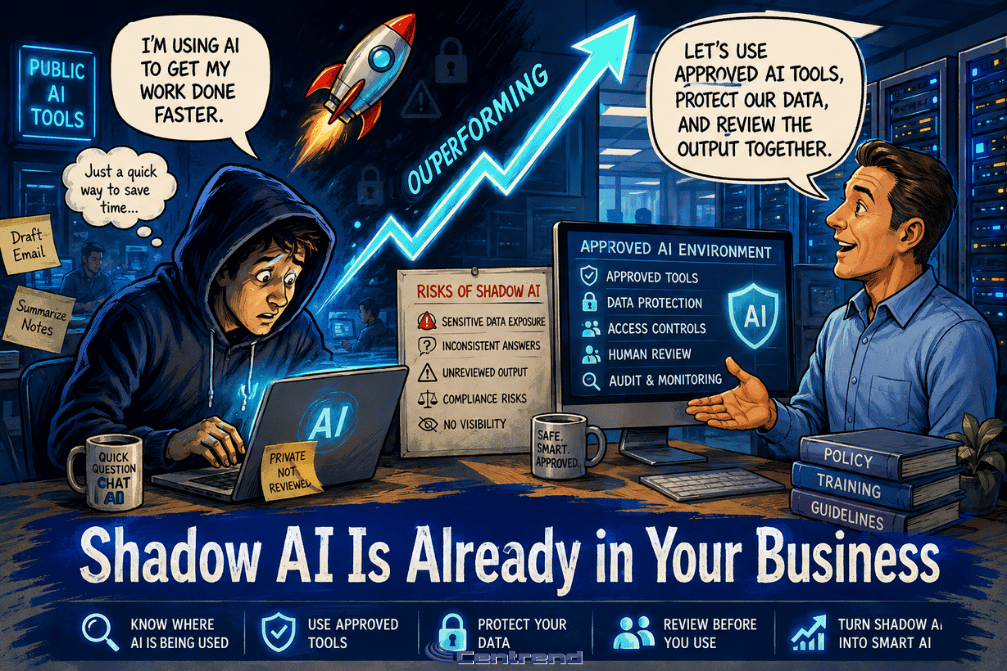
Shadow AI may already be part of your business.
Even if leadership has not approved it.
Nor if IT has not reviewed it.
Even if there is no formal AI policy in place.
Employees may already be using public AI tools to draft emails, summarize notes, write reports, research topics, organize documents, or answer customer questions.
That may seem harmless.
But without visibility, rules, and review, hidden AI use can quietly become a business risk.
Why this matters
Your business may be using more AI than you realize.
The issue is not always that employees are trying to do something wrong.
In many cases, they are trying to save time.
The problem is that public AI tools can create risks when employees do not know:
- Which tools the company approves
- What information they should never be enter
- Who reviews the output
- Where they can use AI safely
- Which tasks should stay outside AI
Ignoring AI use does not stop it.
It only makes it harder to manage.
The problem with shadow AI
Shadow AI happens when employees use AI tools without company approval, IT oversight, or clear security rules.
That can lead to:
- Employees pasting sensitive information into public tools
- Customer data being handled without proper controls
- Company files being summarized in unapproved platforms
- Inconsistent answers going out to customers or partners
- Reports being created from unchecked AI output
- Teams using different tools with different risks
The danger is not always obvious.
The answer may look professional.
The report may look finished.
The customer reply may sound polished.
But if the tool, data, and output were never reviewed, the business may be taking on risk without realizing it.
AI use needs visibility
Businesses cannot manage what they cannot see.
Before creating a larger AI strategy, leaders should first understand how employees are already using AI.
Ask:
- Which AI tools are employees using now?
- What tasks are they using them for?
- Are they entering customer or company data?
- Are the outputs being reviewed before use?
- Are there duplicate tools across departments?
- Does IT know which tools are connected to business accounts?
The goal is not to scare employees away from AI.
The goal is to bring AI use into a safer, clearer process.
Approved tools matter
Not every AI tool should be used for business work.
Some tools may store prompts.
Or use submitted content for training.
Some may lack the access controls, privacy settings, or support your business needs.
That is why businesses need approved tools.
Approved AI tools should be reviewed for:
- Data handling
- Security settings
- Access controls
- User permissions
- Integration needs
- Business fit
- Support and accountability
AI should support the workflow without exposing the business.
Clear rules protect the team
A practical AI policy does not need to be complicated.
It should clearly explain:
- Which AI tools are approved
- What information cannot be shared
- When human review is required
- Which tasks AI can support
- Which decisions must stay human
- Who to ask before using a new AI tool
Simple rules make safer AI easier to follow.
If the policy is too confusing, employees may ignore it.
If there is no policy, they may guess.
Neither is good for the business.
Employees need guidance
AI security is not only a technology issue.
It is also a training issue.
Employees need to understand that they should not enter:
- Customer records
- Financial data
- HR information
- Legal documents
- Passwords or credentials
- Private business plans
- Confidential company files
They also need to know that AI output should be reviewed before it is used in customer communication, reports, decisions, or published content.
AI can help prepare the work.
People still need to protect the result.
The better approach
Shadow AI should be replaced with clear AI use.
Start with visibility.
Then build the rules.
A safer approach includes:
- Review current AI use
- Choose approved tools
- Limit sensitive data exposure
- Set simple usage rules
- Train employees on safe AI habits
- Require human review
- Monitor and adjust over time
The goal is not to stop useful AI.
The goal is to make AI safer, more consistent, and easier to manage.
The bottom line
Shadow AI is already in many businesses.
The question is whether leadership knows where it is being used, what information is being shared, and who is responsible for reviewing the results.
Ignoring hidden AI use does not reduce risk.
It increases it.
Businesses need visibility, approved tools, clear rules, and employee guidance before shadow AI becomes a bigger security problem.
Bring AI use into the open
Centrend helps businesses review AI tools, security risks, employee usage, data protection, and practical policy needs.
Not sure where AI is already being used in your business? Contact Centrend to review your tools, risks, and policies before shadow AI becomes a bigger issue.