
Centrend

Responsible AI

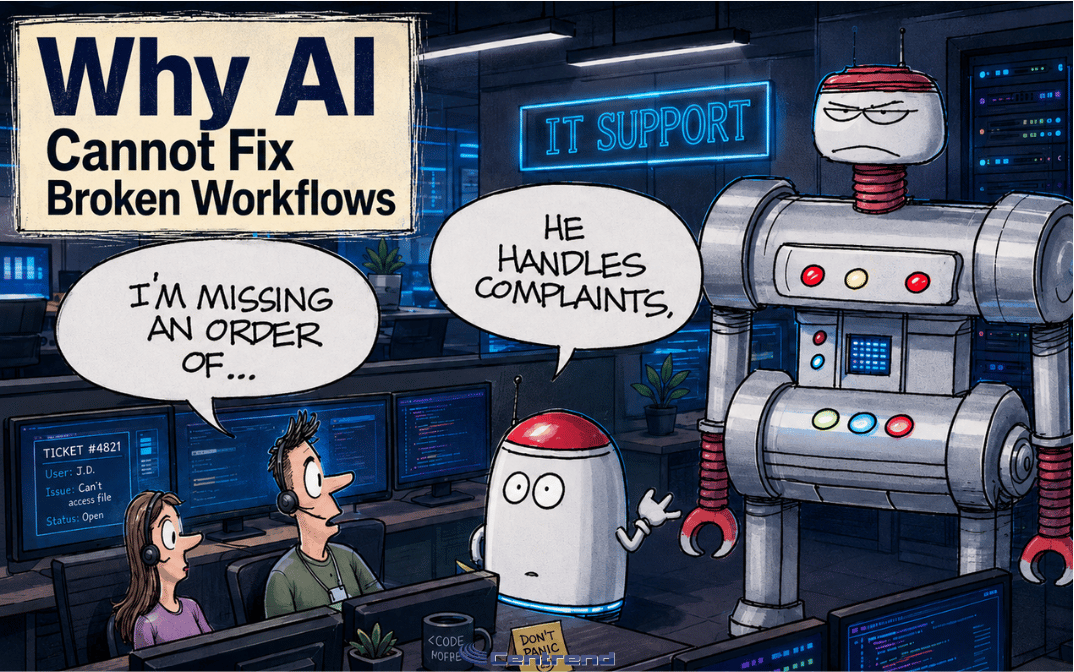
Comic-style IT office showing robots handling a broken customer support workflow under the title “Why AI Cannot Fix Broken Workflows.”

Why AI Cannot Fix Broken Workflows

Why AI cannot fix a broken workflow. It can only move the problems faster. When a process has unclear steps, missing information, repeated work, or inconsistent handoffs, automation does not remove the confusion. It scales it. The problem Many businesses turn to AI because work feels slow or repetitive. But the real issue may be the process itself: AI needs clear instructions, reliable information, and defined outcomes. Without them, even a powerful tool can produce poor results. Why it gets worse A broken workflow may cause an occasional error. An automated broken workflow can repeat that error across customers, systems, and teams. This can lead to: The bottom line: Faster is not better when the process is wrong. Fix the workflow first Before adding AI, map the process from beginning to end. Clarify: Then remove unnecessary steps, correct information gaps, and standardize the handoffs. The process does not need to be perfect. It needs to be clear enough to test safely. Where AI fits Once the workflow is understood, AI can support focused tasks such as: Start with one use case. Keep human review in place. Measure the result before expanding. The big picture AI can strengthen a clear workflow. It cannot rescue a process no one fully understands. Fix the process first. Add AI second. TL;DR Build AI on a Stronger Foundation Centrend AI helps businesses improve workflows, reduce friction, and identify where AI can create practical value. Ready to find the right place to begin? Book a discovery call with Centrend AI.

Why AI Cannot Fix Broken Workflows Read More »
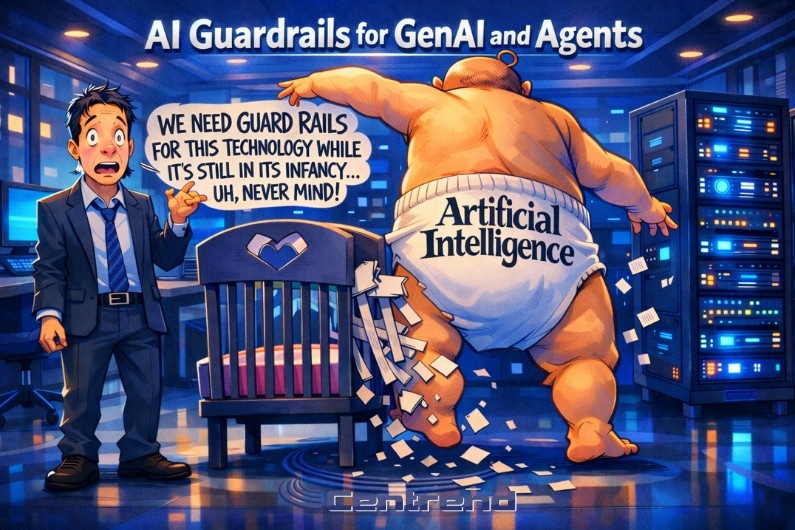
Animated, storybook-style IT office scene with cool blue lighting: a worried businessman points while a huge diapered “Artificial Intelligence” baby smashes a crib and reaches toward glowing server racks; title at the top reads “AI Guardrails for GenAI and Agents.”

AI Guardrails for GenAI and Agents

AI Guardrails for GenAI GenAI is no longer “a tool people try.” It is now part of daily work. Teams use it to draft emails, summarize meetings, write code, build proposals, and answer customer questions. Now add agents.Agents do not just write. They take actions. They can pull files, trigger workflows, update tickets, query systems, and connect to apps. That is where guardrails matter. Guardrails are not fear. Guardrails are how you get speed without losing control. GenAI vs Agents, what changes GenAI (chat and copilots)You ask. It responds. Most risk lives in what people paste in, and what the model outputs. Agents (tools and actions)You ask. It can do. Most risk lives in permissions, connectors, and what the agent is allowed to touch. If you treat agents like chatbots, you will miss the point. Agents need stronger boundaries. What “AI guardrails” really means AI Guardrails for GenAI are a set of rules and controls that answer four questions: If you can answer those clearly, you are already ahead of most teams. The guardrails that hold up in real life 1) Approved tools only Decide which AI tools are allowed, and which are not.Make it easy to do the right thing by providing an approved option. Good guardrail: 2) Clear data rules for prompts and uploads Most teams need a simple line in the sand. Examples of clear rules: This is not about perfect behavior. It is about a clear standard people can follow. 3) Identity and access that match the risk AI access should not be “anyone with a login.” Guardrails to use: 4) Connector control for agents Agents get dangerous when they can connect everywhere. Strong guardrail: A good rule:If the agent can take an action that changes data, it needs tighter approval. 5) Logging you can actually use If you cannot answer “who did what” later, you will lose time in every incident. Logging guardrails: 6) Output checks that prevent costly mistakes GenAI can hallucinate, invent sources, or misstate facts. Agents can act on flawed output. Practical guardrails: 7) Simple training that people will remember AI Guardrails for GenAI. Your policy does not matter if no one follows it. Make training short: Then repeat it. A little, often. A quick “hold up under pressure” checklist If you want to sanity-check your AI setup, start here: If you said “not yet” to a few of these, that is normal. This is new for many teams. Where this connects to CMMC and audit readiness If your organization touches CUI, your AI guardrails should support the same habits you need for strong security programs: The goal is simple. Use AI, keep control, and keep proof. How Centrend helps Centrend helps teams put AI guardrails in place that people follow and auditors can understand: If your team is using GenAI today or planning agents next, it is a great time to set guardrails before usage grows. Want a quick AI Guardrails Review?We can map your current AI use, tighten access, and leave you with a clear action list for the next 30 to 90 days. Book an AI Guardrails Review

AI Guardrails for GenAI and Agents Read More »

Scroll to Top