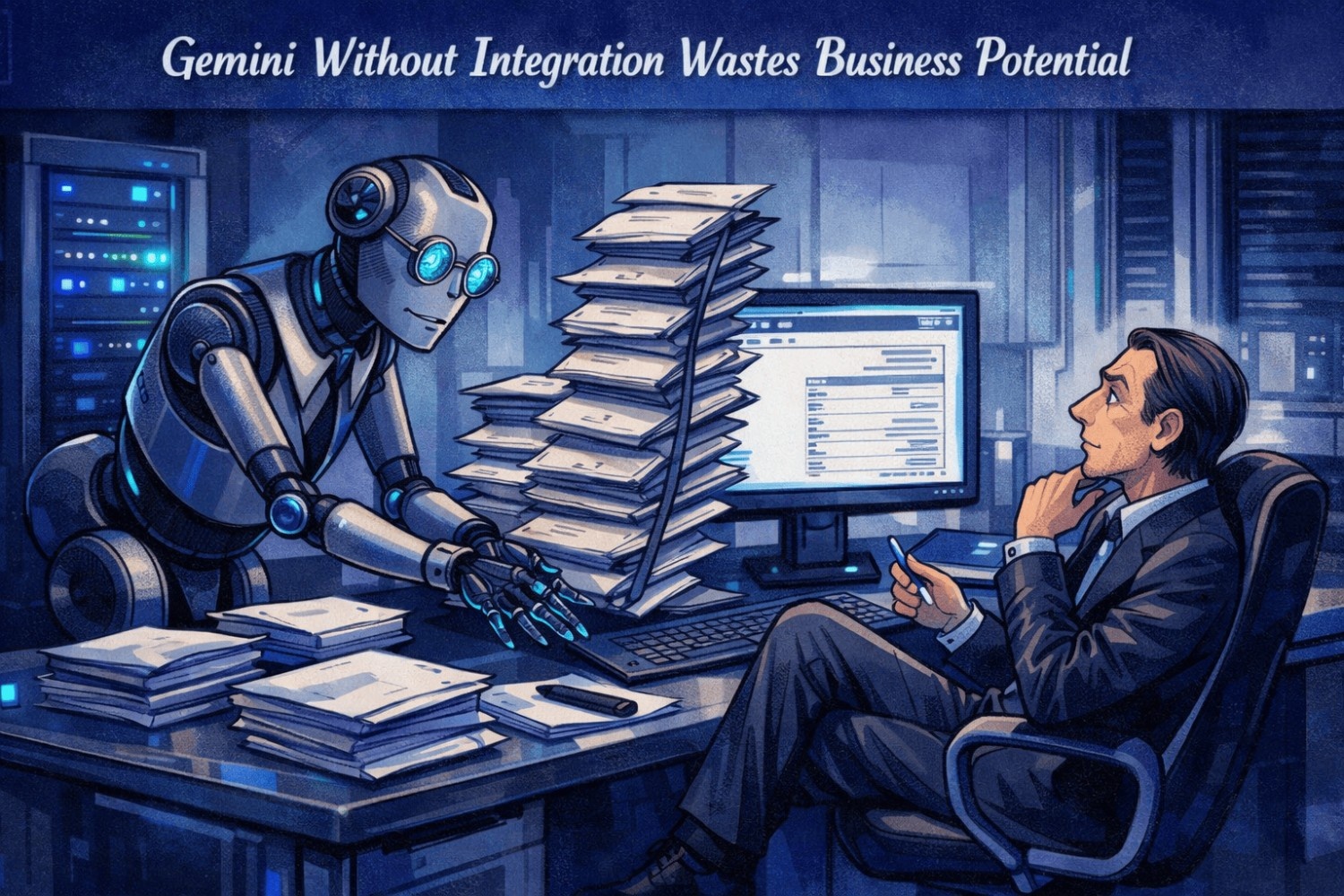
Gemini Without Integration turns powerful AI into missed business value. A lot of businesses say they are “using AI” now. But in many cases, that only means opening a chatbot tab, asking a few questions, and hoping something useful comes out of it. That is not where real business value happens. The real value starts when Gemini is connected to your website, app, platform, support flow, documents, or customer journey. Google’s current Gemini and Vertex AI tools support API-based integration, grounding with Google Search, and supervised fine-tuning for business-specific tasks, which means businesses can move beyond simple prompting and build AI into how work actually gets done The problem with “basic AI use” Generic AI can sound impressive for a minute. It can draft a message, rewrite a paragraph, or answer a surface-level question. But a business does not grow on surface-level answers. If Gemini is not connected to your real systems, it does not know your services, your products, your workflows, your support process, or the information your team depends on every day. That is why many companies try AI, feel the excitement at first, then quietly realize it is not making enough impact. Google’s tuning guidance specifically separates strong prompt use from cases where you need tuning or business-specific adaptation, especially when the task is niche, repetitive, or domain-specific. Why integration changes everything When Gemini is integrated properly, it stops being just another tool people test. It becomes part of the business. Also, it can power a smarter website assistant that answers based on your actual services. It can support your internal team with document-aware help. It can improve search, automate repetitive tasks, summarize files, guide leads, and support customer interactions inside your platform. Vertex AI is built for creating, deploying, and scaling AI applications, and Google’s Gemini ecosystem includes options for grounding and model adaptation that make these use cases practical for production environments. That is the difference. Without integration, AI stays interesting.With integration, AI becomes useful. Where businesses are leaving value behind This is where the loss happens. A business installs AI in the weakest possible way. It stays separate from the website. Separate from the app. From the CRM. And the files. Separate from the daily workflow. So the team still answers the same questions manually. Visitors still leave the website without guidance. Staff still spend time digging through documents. Support still slows down. Leads still drop when nobody is there to respond clearly and quickly. Meanwhile, Gemini can be connected through API, grounded with current web results, and adapted for business tasks with supervised fine-tuning when needed. Google also supports models and workflows designed for production AI use, not just one-off experimentation. What smart businesses do instead Smart businesses do not ask, “Can we use Gemini?” They ask, “Where should Gemini create real value?” That is a much better question. For one business, that may mean a website assistant that answers service questions and helps qualify leads. Another, it may mean an internal tool that can read company files and help staff find answers faster. For another, it may mean smarter app features, workflow automation, document summaries, or better customer support experiences. Google’s official Gemini API documentation supports application integration, and Vertex AI tuning documentation shows that businesses can adapt Gemini for tasks like classification, summarization, extractive question answering, and chat. “Training” Gemini the right way A lot of people use the word “training” loosely. In business, what usually matters is not building a model from scratch. It is making Gemini useful for your actual environment. That can mean: Google’s current documentation makes that distinction clear. Supervised fine-tuning is meant for well-defined tasks with labeled data, while broader business deployment can also rely on grounding and production integration through Vertex AI. So the goal is not just to “have Gemini.” The goal is to shape Gemini around how your business actually works. This is where customer attention shifts People notice when a website helps them clearly. They notice when a platform feels smarter. They notice when answers are faster, support is smoother, and the experience feels more useful from the first click. That is why Gemini integration matters. It is not only about AI capability. It is about customer experience, speed, consistency, and the ability to turn your digital platforms into something more responsive and more valuable. And that matters even more now because businesses can choose different Gemini model options depending on cost, speed, and capability. Google’s current Vertex AI model catalog and pricing pages show active model choices and usage-based pricing, which means implementation decisions can be shaped around actual business needs and budget. The real risk is not doing it halfway The danger is not that Gemini is too advanced. The danger is using it in a shallow way and expecting deep results. If it is not integrated, it stays disconnected from the places where your business wins or loses attention. It stays outside your process. Outside your platform. Outside the customer journey. And when that happens, AI does not fail because it lacks power. It fails because the business never gave it the right place to create value. Final thought Gemini without integration may look modern, but it does not move the business far. The real opportunity is not simply using AI. It is building Gemini into the places where your business communicates, supports, guides, sells, and scales. That is when AI stops being a trend. That is when it starts becoming an advantage. Book a Gemini Integration Strategy Call Keep up with the latest trends in AI, customer support, and smarter business solutions. Subscribe to our mailing list here: https://centrend.com/subscribe/