
Centrend

Managed IT

What Makes an MSP a Technology Partner?

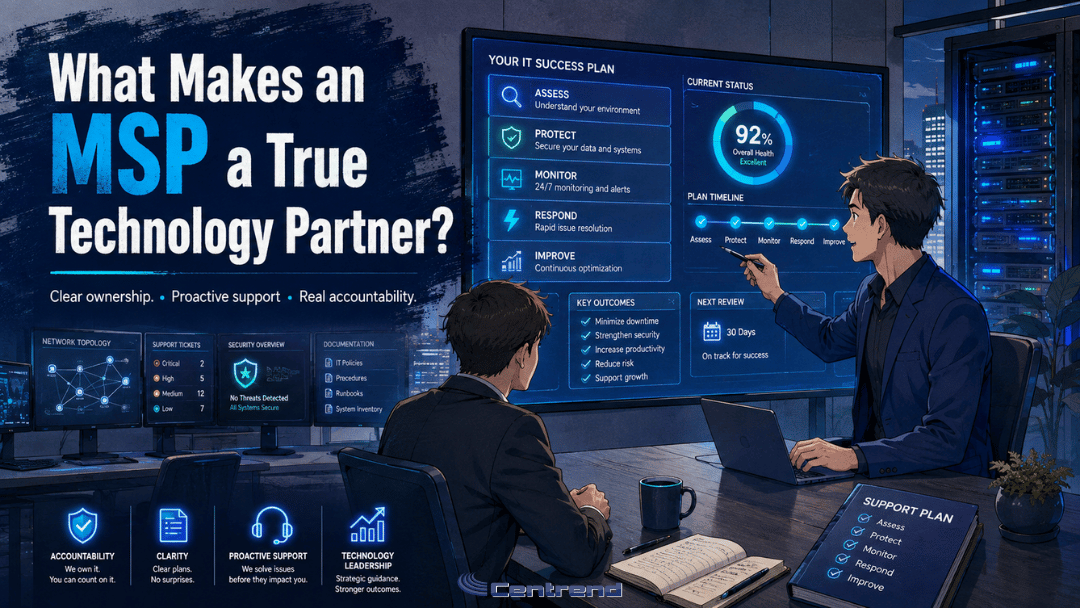
What Makes an MSP a true technology partner comes down to accountability. A good managed service provider should do more than respond when something breaks. It should help your business understand what is happening, who owns the next step, and how small issues can be prevented before they become bigger disruptions. The problem Many businesses do not just struggle with IT issues. They struggle with unclear ownership. When no one knows who is responsible, problems get passed around. And systems are not documented, support takes longer. When communication is unclear, teams lose time trying to explain the same issue again and again. And when no one reviews the bigger pattern, the same problems keep coming back. That is where the right MSP matters. Why it matters IT problems rarely stay isolated. A slow response can delay work. A missed update can create risk. A repeated issue can frustrate the team. A lack of documentation can make every support request harder than it needs to be. The real issue is not only the technology. It is the lack of clarity around the technology. Your business should not have to guess who to call, what happens next, or whether an issue is being handled. The better approach A true MSP brings structure to your technology. That means clear communication, documented systems, proactive support, and one accountable partner who understands your business environment. A strong MSP should help your business with: Good IT support should not leave your team chasing updates. It should create confidence. What accountability looks like Accountability means your MSP does not just close tickets. It looks for patterns. It explains what happened. Where it documents important details. It recommends the next best step. It helps prevent the same issue from happening again. Most importantly, it gives your business one clear technology partner instead of a scattered support process. Why Centrend’s approach is different At Centrend, the goal is simple: Practical guidance.Plain-English communication.Fewer surprises.Stronger technology leadership. Centrend helps businesses move from reactive IT support to a more organized, reliable, and accountable technology experience. That means your team gets more than technical fixes. You get a partner who helps keep your systems clearer, your support process easier to follow, and your business better prepared for what comes next. TL;DR Choose an MSP That Brings Clarity and Accountability Your business deserves IT support that is clear, reliable, and easy to work with. Looking for a managed service provider that brings more ownership, visibility, and accountability to your technology? Contact Centrend today

What Makes an MSP a Technology Partner? Read More »
AI Should Not Learn From Bad Information illustration showing a stressed office worker beside a confused AI robot in a modern IT office, with papers flying and staff working in the background.

AI Should Not Learn From Bad Information

AI Should Not learn from bad information. It can write quickly. Or can sound polished. It can organize answers in seconds. But if the information behind it is outdated, incomplete, duplicated, or wrong, the result can still create serious business risk. A clean AI answer is not always a correct answer. Why this matters Businesses are starting to use AI for emails, reports, research, internal updates, customer communication, and workflow support. That can be helpful. But AI depends on the information it is given. If it pulls from old files, conflicting records, outdated policies, or disconnected systems, it can produce answers that look professional but are not reliable. That is where the danger starts. The mistake may not look obvious. It may look like a finished report. A helpful reply. A confident recommendation. A clear summary. But behind the clean wording, the information may be wrong. Bad information creates business risk AI can move work faster. But it can also move bad information faster. That can lead to: The problem is not only the AI tool. The problem is the information connected to it. If the source is weak, the output will be weak too. Where bad information usually starts Bad AI output often begins with everyday business issues. Old documents stay in shared folders. Teams keep multiple versions of the same file. Customer records are incomplete. ERP or CRM data does not match. Policies are updated in one place but not another. Employees save important information outside approved systems. These issues may already slow the business down. AI can make them more visible. And sometimes, it can make them worse. AI should use approved sources AI should not pull from everything. It should pull from what the business trusts. Before using AI in a workflow, businesses need to know: This is especially important for customer communication, financial reports, HR information, legal content, cybersecurity, and operational decisions. AI should support better work. It should not spread outdated or unapproved information. Clean data comes before useful AI Before expanding AI, businesses should review the information it will depend on. Start with simple questions: These questions help prevent AI from becoming another source of confusion. They also make the output easier to trust. Human review still matters Even with clean data, AI still needs review. AI can miss context. It can misunderstand instructions. It can sound certain when the answer needs checking. That is why people must stay responsible for the final result. A safer AI workflow should include: AI can support the process. People must protect the accuracy. The better approach Do not start by asking AI to do everything. Start by improving what AI will learn from. Clean the data. Organize the documents. Confirm the sources. Control access. Review the output. Then use AI where it can safely support the work. That is how businesses move from random AI use to practical AI value. The bottom line AI should not learn from bad information. If the data is outdated, scattered, or unreliable, AI can create polished answers that still lead to mistakes. The goal is not just faster output. The goal is trusted output. Reliable AI starts with reliable information, secure systems, and people who know what needs to be checked. Make your information AI-ready Centrend helps businesses review systems, data sources, workflows, and security controls so AI can support daily work with less risk and more confidence. Not sure if your business information is ready for AI? Contact Centrend to review the systems, sources, and workflows your AI will depend on.

AI Should Not Learn From Bad Information Read More »

Scroll to Top