
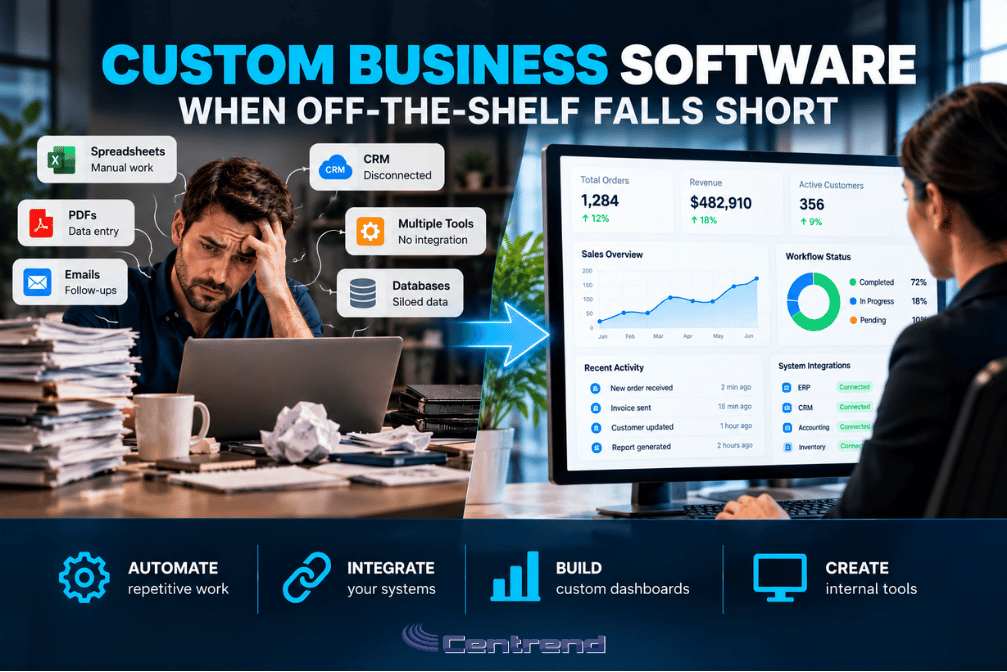
Custom Business Software becomes valuable when standard tools start creating more work instead of removing it.
At first, off-the-shelf software seems like the easy answer.
Install it.
Configure it.
Train the team.
Then the workarounds begin.
More spreadsheets. Copy and paste. More manual entry. Disconnected systems.
The software is supposed to help the business.
Instead, the business starts working around the software.
When Software Becomes the Problem
Your business has its own:
- Workflows
- Approvals
- Data
- Reports
- Integrations
- Customer needs
- Internal processes
Standard software cannot always fit them all.
So teams create workarounds.
And workarounds create:
- Duplicate work
- Data entry errors
- Delays
- Confusing handoffs
- Inconsistent information
- Extra review
If your team spends too much time managing the software, it’s time to rethink the process.
Don’t Buy Another Tool Yet
The answer isn’t always another software platform.
First ask:
What is actually slowing the business down?
Where is information being entered twice?
Are systems disconnected?
Where are employees relying on spreadsheets?
Do the workflow break down?
Where is important information difficult to find?
Find the gap before choosing the tool.
Build What the Business Needs
Custom programming can fill the gaps standard software cannot.
Connect Systems
Move information between platforms without repeated manual entry.
Build Internal Tools
Create simple tools around the way your team actually works.
Create Dashboards
Bring important information together so teams can see what matters faster.
Improve Existing Applications
Add needed functionality without replacing everything.
The goal isn’t more software.
It’s less unnecessary work.
Custom Doesn’t Mean Rebuild Everything
You don’t need to replace your entire technology stack.
Sometimes you need:
One integration.
One dashboard.
One internal tool.
One automated workflow.
The right solution depends on the problem.
If existing software works, keep it.
If it creates unnecessary work, improve the process around it.
Start With the Workflow
Before building anything, map the process.
Ask:
- What happens today?
- Where does work slow down?
- Who owns each step?
- Which systems are involved?
- Where is data entered twice?
- What can be automated?
- What still needs human review?
Map the work first. Then build around it.
What Better Software Should Do
Good technology should help your team:
- Reduce repetitive work
- Connect systems
- Find information faster
- Improve reporting
- Reduce errors
- Save time
- Make better decisions
Technology should support the way your business works, not force your business to work around it.
How Centrend Helps
Centrend helps businesses identify where standard software stops fitting.
That can mean:
Custom programming
System integrations
Internal tools
Custom dashboards
Workflow improvements
Application modernization
We start with the business problem, understand the workflow, and identify where technology can remove unnecessary work.
Not more tools. Better-fit technology.
TL;DR
- Standard software isn’t always the best fit.
- Workarounds can create unnecessary work.
- Integrations can connect disconnected systems.
- Dashboards can make information easier to use.
- Custom tools can solve specific business problems.
- Start with the workflow, not the software.
Make Your Technology Fit Your Business
When standard software stops fitting, you don’t always need to start over.
You may just need a better way to connect, improve, and build around what you already have.