
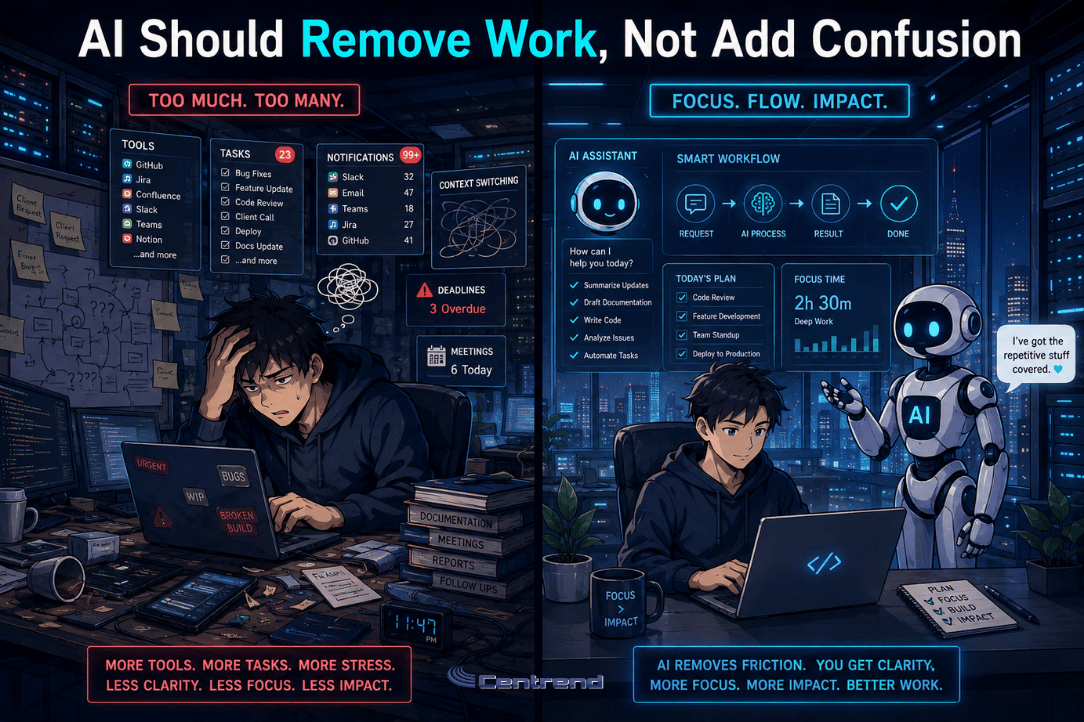
AI Should Remove work that slows your team down, not create another layer of tasks, tools, and confusion.
Many businesses are interested in AI because they want faster work, better organization, and less manual effort. But when AI is added without a clear purpose, it can create the opposite result.
Extra tools.
More questions.
Added review.
More confusion.
That is not the goal.
The goal is to make work simpler.
Why this matters
AI should help your team spend less time on repetitive work and more time on decisions, customers, and growth.
But if every employee uses a different tool, follows a different process, or trusts AI output without review, the business can quickly lose control of the workflow.
What was meant to save time can become another problem to manage.
Where confusion starts
AI can create confusion when businesses do not define how it should be used.
Common issues include:
• Employees using different AI tools without guidance
• Sensitive information being entered into public platforms
• AI-generated content being used without review
• Teams getting inconsistent answers from different tools
• Extra time spent fixing unclear or inaccurate output
When this happens, AI does not remove work.
It adds more of it.
What smarter AI use looks like
AI works best when it supports a clear process.
That means your business should know:
• What tasks AI can help with
• What information should never be entered
• Which tools are approved
• Who reviews the final output
• How AI should fit into daily workflows
The simpler the process, the easier it is for your team to use AI safely and consistently.
Start with the work that repeats
The best place to start is not the most complicated task.
Start with work your team repeats often.
That may include:
• Drafting emails
• Summarizing meetings
• Organizing notes
• Creating report outlines
• Building checklists
• Researching basic topics
• Preparing internal updates
These are good starting points because AI can help create structure, save time, and reduce blank-page work.
Your team still reviews the final result, but they do not have to start from zero.
Keep people in control
AI should not become the final decision-maker.
It should support people who already understand the business, the customer, and the context.
Human review matters because your team still needs to check accuracy, tone, privacy, and business fit.
AI can create the draft.
People make it right.
Make AI fit your business
AI should not force your team into a workflow that does not match how your business operates.
It should fit your process, your brand voice, your customer standards, and your internal rules.
That is where the real value starts.
Not just using AI.
Using AI in a way that actually supports how your business works.
The bottom line
AI should remove work, not add confusion.
Used well, it can help your team save time, organize information, and work with more clarity.
Used without a plan, it can create risk, inconsistency, and extra review work.
The smart approach is simple:
Start with clear use cases.
Set rules for your team.
Protect sensitive data.
Review important outputs.
Make AI fit the way your business works.
That is how AI becomes useful, not overwhelming.
Make AI work the way your business works.
Centrend can help your business find practical ways to use AI, reduce confusion, and build safer workflows that support your team.