
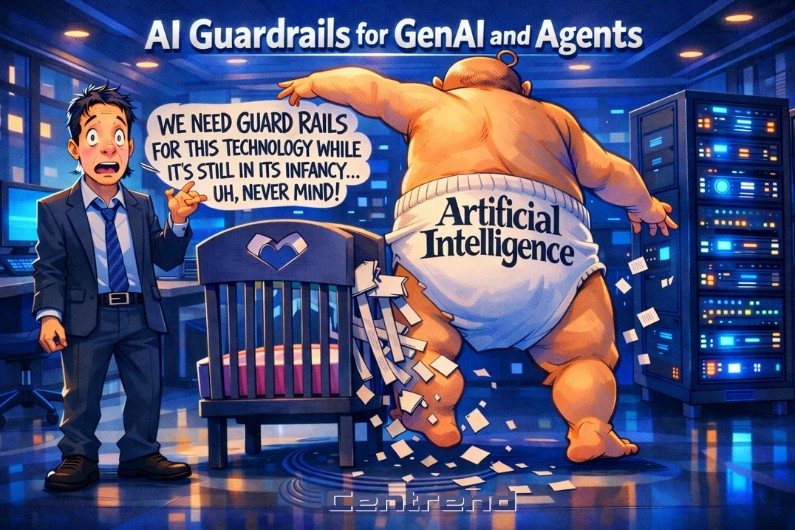
AI Guardrails for GenAI
GenAI is no longer “a tool people try.” It is now part of daily work. Teams use it to draft emails, summarize meetings, write code, build proposals, and answer customer questions.
Now add agents.
Agents do not just write. They take actions. They can pull files, trigger workflows, update tickets, query systems, and connect to apps.
That is where guardrails matter.
Guardrails are not fear. Guardrails are how you get speed without losing control.
GenAI vs Agents, what changes
GenAI (chat and copilots)
You ask. It responds. Most risk lives in what people paste in, and what the model outputs.
Agents (tools and actions)
You ask. It can do. Most risk lives in permissions, connectors, and what the agent is allowed to touch.
If you treat agents like chatbots, you will miss the point. Agents need stronger boundaries.
What “AI guardrails” really means
AI Guardrails for GenAI are a set of rules and controls that answer four questions:
- Who can use AI
- What data can go in
- What the AI can access and do
- How you prove what happened
If you can answer those clearly, you are already ahead of most teams.
The guardrails that hold up in real life
1) Approved tools only
Decide which AI tools are allowed, and which are not.
Make it easy to do the right thing by providing an approved option.
Good guardrail:
- “Use these approved AI tools for work tasks. Do not use personal accounts for company data.”
2) Clear data rules for prompts and uploads
Most teams need a simple line in the sand.
Examples of clear rules:
- Never paste secrets, passwords, or keys
- Never paste customer data unless the tool is approved for it
- Never paste CUI into tools that are not authorized for CUI workflows
- Use redaction or summaries when possible
This is not about perfect behavior. It is about a clear standard people can follow.
3) Identity and access that match the risk
AI access should not be “anyone with a login.”
Guardrails to use:
- MFA for AI tools
- Role-based access for features like data connectors, plugins, and agents
- Least privilege for who can create agents and who can publish them to teams
- Separate admin roles from everyday users
4) Connector control for agents
Agents get dangerous when they can connect everywhere.
Strong guardrail:
- Allow only approved connectors
- Limit what each connector can access
- Use read-only access where possible
- Require review before an agent can write, send, delete, or publish
A good rule:
If the agent can take an action that changes data, it needs tighter approval.
5) Logging you can actually use
If you cannot answer “who did what” later, you will lose time in every incident.
Logging guardrails:
- Log sign-ins and admin changes
- Log agent actions and tool calls
- Log file access through connectors
- Review logs on a schedule, not only after something goes wrong
6) Output checks that prevent costly mistakes
GenAI can hallucinate, invent sources, or misstate facts. Agents can act on flawed output.
Practical guardrails:
- Require human review for customer-facing answers
- Add “confirm before action” steps for agents
- Use allowlists for tools and commands
- Add basic safety checks for sensitive actions, like sending files or changing access
7) Simple training that people will remember
AI Guardrails for GenAI. Your policy does not matter if no one follows it.
Make training short:
- What is allowed
- What is not allowed
- Where to use approved AI
- What to do if unsure
Then repeat it. A little, often.
A quick “hold up under pressure” checklist
If you want to sanity-check your AI setup, start here:
- Do we have an approved AI tool list
- Do we have a clear rule for what data can be used
- Are MFA and least privilege enforced
- Are agents limited by connectors and permissions
- Are high-impact actions gated with review
- Can we produce logs that show access and actions
- Do staff know the rules in plain language
If you said “not yet” to a few of these, that is normal. This is new for many teams.
Where this connects to CMMC and audit readiness
If your organization touches CUI, your AI guardrails should support the same habits you need for strong security programs:
- Access control and least privilege
- Identity verification
- Audit logging and review
- Configuration discipline
- Incident readiness
The goal is simple. Use AI, keep control, and keep proof.
How Centrend helps
Centrend helps teams put AI guardrails in place that people follow and auditors can understand:
- Approved AI tool and agent standards
- Permission and connector design for agents
- MFA and role-based access tuning
- Logging, review cadence, and incident runbooks
- Clear policies and training that fit real work
If your team is using GenAI today or planning agents next, it is a great time to set guardrails before usage grows.
Want a quick AI Guardrails Review?
We can map your current AI use, tighten access, and leave you with a clear action list for the next 30 to 90 days. Book an AI Guardrails Review