
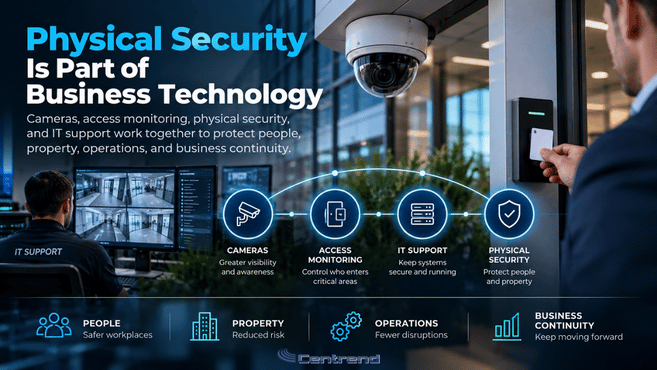
Physical Security is not separate from your technology strategy.
Your cameras use networks. Access systems control who enters critical spaces. Monitoring creates data. Alerts need to reach the right people. And when something goes wrong, your IT and security systems need to work together.
If those pieces are disconnected, the business has a gap.
The problem
Businesses often think about cybersecurity and physical security separately.
IT protects the network.
Cameras watch the building.
Access systems manage doors.
Employees handle incidents.
But real-world risks do not stay in one category.
An unauthorized person entering a restricted area can become an IT problem.
A disconnected camera can leave an incident undocumented.
A failed access system can disrupt operations.
A poorly secured server room can put business systems and sensitive information at risk.
Physical and digital security are increasingly connected.
Why this matters
Your business depends on more than computers.
It depends on people, facilities, equipment, data, and the systems connecting everything together.
A security gap can affect:
- Employees and visitors
- Offices and facilities
- Servers and network equipment
- Inventory and equipment
- Sensitive information
- Daily operations
- Business continuity
The question is not simply whether you have cameras.
The better question is:
Does your security environment work as one system?
Cameras should provide visibility
Cameras are more useful when they do more than record footage.
They should help your business understand what happened, when it happened, and where attention is needed.
A stronger surveillance strategy considers:
- Camera placement
- Image quality
- Remote visibility
- Recording reliability
- Storage
- Network connectivity
- Monitoring
- Access to footage
A camera that does not capture the right area or cannot be accessed when needed provides limited value.
Visibility needs planning.
Access monitoring protects more than doors
Not every employee needs access to every area.
Server rooms, offices, storage areas, equipment rooms, and other sensitive spaces may require tighter controls.
Access monitoring can help businesses understand:
- Who entered
- When they entered
- Which areas they can access
- Whether permissions are still appropriate
- When access should be removed
That becomes especially important when employees change roles or leave the company.
Physical access should be managed with the same care as digital access.
IT makes physical security stronger
Modern physical security depends heavily on technology.
Cameras may connect to the network.
Access systems may depend on software.
Alerts may travel through internet-connected platforms.
Footage may require secure storage.
Remote monitoring may depend on reliable connectivity.
That means IT support matters.
Weak passwords, outdated systems, poor network configuration, or excessive permissions can weaken otherwise useful security technology.
A security device is only as strong as the environment supporting it.
Security should support business continuity
Physical security is also about keeping the business running.
Consider what happens if:
A critical area becomes inaccessible.
A camera system goes offline.
Equipment is damaged or stolen.
A facility incident interrupts operations.
No one can quickly determine what happened.
The impact can go beyond the original incident.
Employees may lose access to systems.
Operations may stop.
Customers may wait.
Recovery may take longer.
Good security planning helps businesses prepare before those situations happen.
The better approach
Bring physical security and IT into the same conversation.
Review:
- Cameras and surveillance coverage
- Physical access controls
- Network connectivity
- User permissions
- Monitoring and alerts
- System documentation
- Backup and recovery needs
- Incident response
- Business continuity
Then identify the gaps.
The goal is not more technology.
The goal is better protection with fewer blind spots.
How Centrend helps
Centrend helps businesses connect technology, cybersecurity, and physical security into a clearer business strategy.
That means looking beyond individual devices and considering how cameras, access monitoring, networks, systems, and IT support work together.
The focus is practical:
Protect people.
And property.
Protect systems.
Keep operations moving.
TL;DR
- Physical security is part of business technology
- Cameras need reliable networks, storage, and monitoring
- Access controls help protect sensitive areas and systems
- IT and physical security should not operate separately
- Better visibility reduces security blind spots
- Stronger security supports business continuity
Protect more than the network
Cybersecurity matters.
So does what happens outside the screen.
When physical security, access monitoring, surveillance, and IT work together, businesses gain stronger visibility and a clearer approach to protecting what keeps them running.
Want to review the physical and digital security gaps around your business? Talk to Centrend about building a more connected approach to protection.