
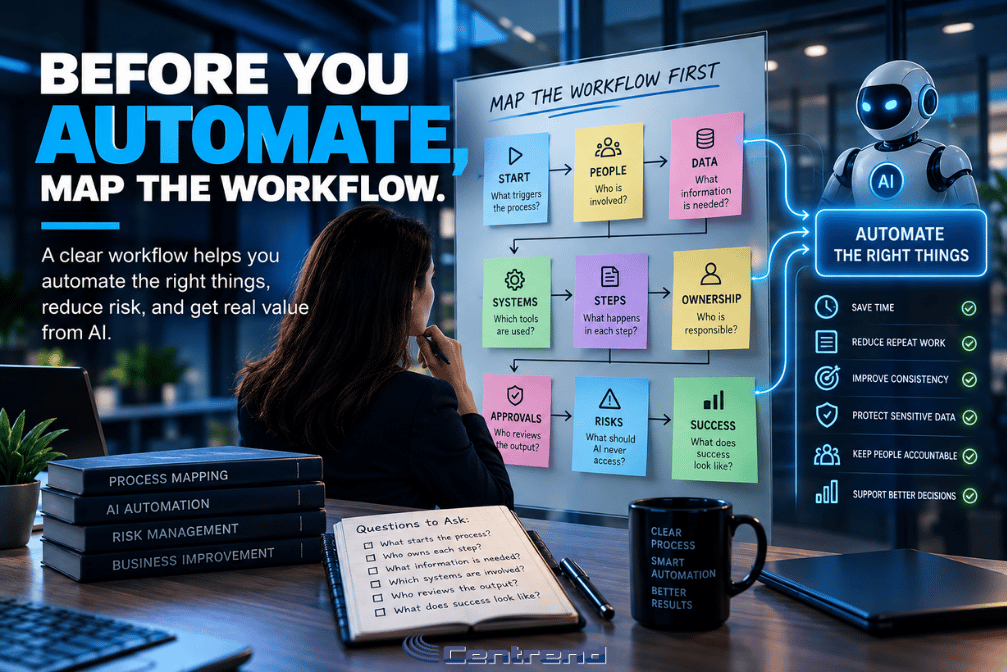
Before You Automate anything, make sure the workflow is clear.
That sounds simple.
But many businesses skip this step.
They see a task that takes too long, choose an AI tool, and try to make it faster.
The problem is that speed does not fix confusion.
If the process is unclear, automation can make the wrong work happen faster.
The problem
AI and automation are often treated like shortcuts.
A team wants fewer manual tasks.
A manager wants faster reports.
A business wants quicker replies.
A department wants less repeated work.
Those are good goals.
But if the process behind the work is messy, automation may only repeat the mess.
That can create:
- Faster mistakes
- Confusing handoffs
- Duplicate work
- Unclear responsibility
- Inaccurate outputs
- Extra review time
- More risk around sensitive data
Automation should not begin with the tool.
It should begin with the workflow.
Why this matters
Every workflow has moving parts.
People.
Systems.
Files.
Approvals.
Data.
Decisions.
Review steps.
If those parts are not clear, AI may not know what should happen next.
The business may not know either.
That is where problems start.
One person may use the wrong input.
Another may skip a review step.
Someone else may trust an output that should have been checked.
A faster process is only valuable when the process is already right.
The better approach
Before using AI or automation, map the workflow.
Look at how the work happens today.
Ask:
- What starts the process?
- Who owns each step?
- What information is needed?
- Which systems are involved?
- What inputs are approved?
- What should AI never access?
- Who reviews the final output?
- What does success look like?
These questions help reveal whether the task is ready for automation.
Sometimes it is.
Sometimes the process needs cleanup first.
Clear process comes first
A clear process helps everyone understand the path from start to finish.
It shows what needs to happen, who is responsible, and where delays or confusion appear.
Without that clarity, AI may support the wrong step.
Or automate work that should still involve a person.
The goal is not to automate everything.
The goal is to automate the right things.
Ownership matters
Every automated workflow needs an owner.
Someone needs to know:
- Who maintains the process
- Who checks the output
- Who approves changes
- Who handles errors
- Who decides when the workflow should stop or change
AI can assist the work.
It should not own the outcome.
Accountability still belongs to people.
Approved inputs protect the business
AI output is only as good as the information behind it.
If the input is outdated, incomplete, or unapproved, the result may look polished but still be wrong.
That is why businesses need clear input rules.
What files can be used?
Which data sources are trusted?
What customer or company information should stay out?
Which tools are approved?
These rules help protect privacy, accuracy, and trust.
Review steps keep AI useful
Human review is not a delay.
It is a safeguard.
AI can draft, summarize, organize, and route information.
But people still need to confirm the facts, check the tone, protect sensitive details, and make sure the final result fits the business.
Review steps help prevent small errors from becoming bigger problems.
They also help teams trust the workflow over time.
What better automation looks like
Good automation should feel controlled.
It should reduce work without removing visibility.
It should help teams:
- Save time
- Reduce repeated tasks
- Improve consistency
- Protect sensitive data
- Keep people accountable
- Make review easier
- Support better decisions
That only happens when the workflow is mapped first.
How Centrend helps
Centrend helps businesses look at the workflow before choosing the tool.
That means identifying the real problem, clarifying ownership, reviewing inputs, adding guardrails, and defining where human review belongs.
The goal is practical automation.
Not more confusion.
Nor more disconnected tools.
Not faster errors.
Just clearer workflows that help the business move with more confidence.
TL;DR
- AI and automation should start with the workflow
- Speed does not fix a broken process
- Clear ownership keeps people accountable
- Approved inputs protect data and accuracy
- Review steps help prevent mistakes
- Better automation starts with clarity, not tools
Automate the right way
Before your business tries to speed up a process, make sure the process is ready.
A clear workflow helps AI and automation create real value without adding confusion, risk, or extra review work.
Talk to Centrend about mapping your workflow before you automate.