
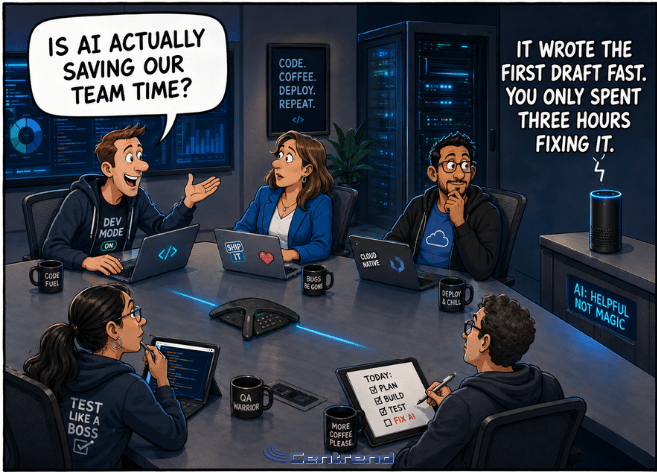
Is AI actually saving time by creating an email in seconds.
Summarize a meeting in minutes.
Turn scattered notes into a polished report.
But faster output does not always mean less work.
If your team spends more time correcting mistakes, checking facts, rewriting generic responses, or managing too many tools, AI may be producing work faster without actually saving time.
That is the difference between AI activity and AI value.
Why this matters
Many businesses measure AI by what it produces.
More drafts.
Deeper summaries.
More content.
Faster answers.
But output alone does not prove productivity.
The better question is:
Did AI reduce the total amount of work required?
A task is not truly faster if the final result still needs heavy editing, repeated review, or a complete rewrite.
AI should remove friction.
Not hide it somewhere else.
Faster output can create hidden work
AI may finish the first draft quickly.
Then the team has to:
- Correct inaccurate information
- Rewrite the tone
- Remove generic language
- Check sensitive details
- Compare the output with the original source
- Fix formatting or missing context
- Repeat the task in another system
That extra work is easy to miss.
The AI step looks fast.
The full process is not.
Measure the whole workflow
Do not measure how quickly AI creates the first output.
Measure the full task from beginning to end.
Ask:
- How long did the task take before AI?
- How long does it take now?
- How much review is required?
- How often does the output need correction?
- Did AI remove steps or add new ones?
- Is the final result more consistent?
This reveals whether AI is creating real value or simply moving the work around.
What real time savings look like
Useful AI should create a clear improvement.
That may include:
- Faster first drafts with less editing
- Shorter meeting follow-up time
- Fewer repetitive administrative steps
- Better-organized information
- Faster response preparation
- More consistent internal updates
- Less time searching across documents
- Fewer handoff delays
The strongest AI workflows do not just produce work quickly.
They make the entire process easier to manage.
Start with a baseline
Before adding AI to a workflow, understand how the work currently happens.
Track:
- Time spent
- Number of steps
- People involved
- Common delays
- Frequent mistakes
- Review requirements
Without a baseline, there is nothing meaningful to compare.
You may know that AI feels faster.
But you will not know whether it actually improved the workflow.
Test one process first
Do not measure AI across the entire business at once.
Choose one clear task.
Good starting points may include:
- Summarizing meeting notes
- Drafting routine internal updates
- Organizing research
- Preparing report outlines
- Turning rough notes into action items
- Drafting first-pass customer responses
Keep the test focused.
Measure the results.
Then decide whether the workflow should be improved, expanded, or stopped.
Watch for warning signs
AI may not be saving time when:
- Employees rewrite most of the output
- The same information is entered more than once
- Several tools perform the same function
- Review takes longer than the original task
- Errors create additional follow-up work
- The team does not trust the result
- No one knows who owns the final output
These are signs that the workflow needs improvement.
Adding more AI will not solve them.
Quality still matters
Time saved is useful only when the result remains accurate, secure, and aligned with the business.
A faster customer reply has little value if it contains incorrect information.
A quick report creates risk if the numbers are not checked.
A polished message can still damage trust if it does not sound like your company.
Measure speed.
But also measure:
- Accuracy
- Consistency
- Rework
- Customer impact
- Employee confidence
- Data safety
Productivity is not just producing something faster.
It is producing useful work with less friction.
Keep people responsible
AI can support the workflow.
People must still own the outcome.
Every AI-supported process should have:
- A clear purpose
- An approved tool
- Defined review steps
- A person responsible for the result
- A measurable business goal
This keeps AI focused on useful work instead of becoming another tool the team has to manage.
Improve before you expand
When a workflow saves time and maintains quality, improve it before using AI elsewhere.
Refine the instructions.
Remove unnecessary steps.
Clarify review responsibilities.
Track results over time.
Then expand only when the value is clear.
The goal is not to use more AI.
The goal is to create better work with less effort.
The bottom line
AI may produce work faster.
But that does not automatically mean your team is saving time.
Real value appears when AI reduces the total workload, limits rework, improves consistency, and helps the process move more smoothly.
Measure the full workflow.
Not just the first draft.
Because the best AI result is not more output.
It is less unnecessary work.
Make AI value measurable
Centrend can help your business review existing workflows, identify where AI can reduce real work, and build a practical process with measurable results.
Is AI actually saving your team time? Contact Centrend to find out where it is helping, where it is adding work, and what to improve next.
Explore more practical AI guidance on the Centrend Blog: https://centrend.com/blog/