
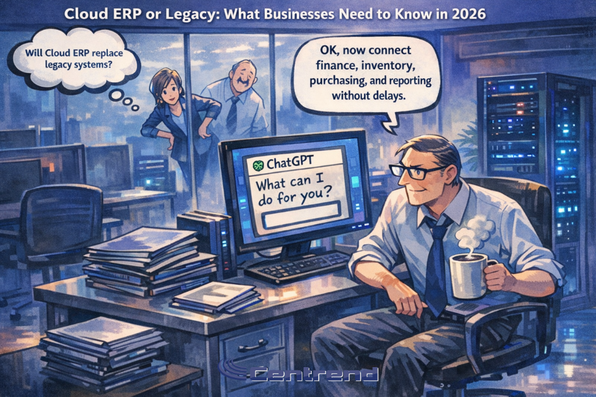
Cloud ERP or Legacy
Your ERP might still be running.
Team may still be using it every day.
Reports may still come through.
Operations may still move forward.
But in 2026, that is no longer enough.
The real question is not whether your ERP still works.
The real question is whether it is helping your business move faster, make better decisions, and grow without friction.
For many companies, legacy ERP feels familiar. Safe. Proven.
But behind that comfort, old systems often create delays, extra cost, limited flexibility, and daily workarounds that slowly wear teams down.
Cloud ERP is changing that.
It gives businesses a more modern way to run finance, operations, inventory, purchasing, and reporting with better speed, visibility, and room to adapt.
Why this matters now
Business is moving faster than it used to.
In 2026, companies are under pressure to:
- make decisions faster
- reduce manual work
- improve visibility across teams
- connect systems more smoothly
- stay secure and compliant
- scale without creating more chaos
That pressure exposes the weakness of older ERP systems very quickly.
A legacy ERP may still support your business.
But it can also quietly slow it down in places that matter most.
What legacy ERP often looks like today
Legacy ERP is usually not a disaster all at once.
It becomes a problem in smaller ways first:
- reports take longer
- updates feel risky
- support costs grow
- integrations are harder
- workflows stay manual
- teams depend on workarounds
- simple changes take too much time
At first, these issues can seem manageable.
But over time, they create something bigger:
- slower decisions
- lost efficiency
- frustrated staff
- weaker responsiveness
- higher operational drag
This is where many businesses get stuck.
They are not fully broken, so they delay change.
But they are not truly moving well either.
Why cloud ERP is getting more attention
Cloud ERP stands out because it is built for change.
Instead of forcing businesses to keep adjusting to an older system, it gives them a system that is easier to update, easier to connect, and easier to scale.
That usually means:
- better access to real-time data
- easier collaboration across teams
- faster system improvements
- lower dependence on heavy manual processes
- more flexibility as needs change
- stronger support for connected business tools
This is why more businesses are looking closely at cloud ERP now.
They do not just want software that records activity.
They want software that helps the business respond faster and operate smarter.
Cloud ERP vs Legacy ERP: the real difference
Here is the simplest way to look at it:
Legacy ERP
- built for older business environments
- often harder to update
- can require more maintenance
- may depend on custom fixes
- often slower to adapt
- can limit visibility and flexibility
Cloud ERP
- built for modern connected operations
- easier to scale
- better for ongoing improvements
- supports stronger integration
- improves access to live data
- helps teams work with less friction
Legacy ERP helps you keep things running.
Cloud ERP helps you keep improving.
That is the real divide in 2026.
The hidden cost of staying with legacy ERP
The biggest risk with legacy ERP is not always failure.
It is delay.
Delay in reporting.
Setback in visibility.
Setback in change.
Stalled in growth.
When a business has to work around its own system, the cost shows up everywhere:
- more staff time
- slower response
- more errors
- missed insights
- weaker agility
- harder expansion
That cost can stay hidden because it builds quietly.
A company may think the system is saving money because it already exists.
But in reality, it may be costing the business more every month in inefficiency, complexity, and lost momentum.
What businesses should ask in 2026
Before staying with a legacy ERP just because it feels familiar, businesses should ask:
- Is our ERP helping us move faster or slowing us down?
- Can our current system support growth without more complexity?
- Are our teams working efficiently or relying on workarounds?
- Can we get the visibility we need without delay?
- Is our ERP easy to connect with other important tools?
- Are we investing in progress, or just maintaining old limits?
These questions matter because ERP is not just a back-office system anymore.
It shapes how well a business can act, adapt, and compete.
When legacy ERP becomes a warning sign
A legacy ERP may be holding your business back if:
- upgrades keep getting postponed
- reporting feels too slow
- integrations are expensive or messy
- teams rely on spreadsheets outside the system
- daily work depends on manual fixes
- the system feels hard to change
- growth creates more strain instead of more opportunity
These are not small signs.
They often point to a bigger issue:
the business has outgrown the system, even if the system has not fully failed yet.
Why cloud ERP is a stronger long-term move
Cloud ERP is not just about being newer.
It is about being more ready for what business needs now.
That includes:
- speed
- flexibility
- visibility
- connected workflows
- better adaptability
- smoother support for change
For businesses that want to grow without carrying the weight of outdated processes, cloud ERP is often the stronger direction.
Not because it is trendy.
Because it removes friction that older systems keep creating.
Bottom line
A legacy ERP may feel stable.
A cloud ERP is built to move with the business.
That matters in 2026.
Because today, the companies that stay competitive are not just the ones that keep operating.
They are the ones that can adjust faster, see clearer, and scale with less resistance.
If your ERP is creating extra work, slowing visibility, or making change harder, that is not just an IT issue.
That is a business issue.
Final thought
Holding onto a legacy ERP can feel like the easier choice.
But when the system starts costing time, flexibility, and momentum, staying the same stops being the safe option.
In 2026, businesses do not just need ERP that works.
They need ERP that works for where they are going. Book a Cloud ERP Strategy Call