
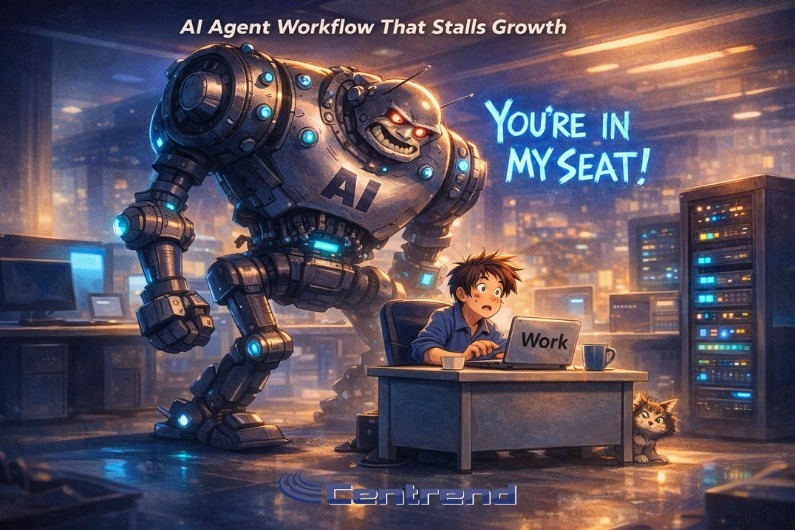
AI Agent Workflow
Most teams do not lose momentum because of bad ideas.
They lose momentum in the handoff between one AI step and the next.
A lead comes in.
One agent qualifies it.
Outreach drafting comes next.
Urgency scoring follows.
CRM updates close the loop.
Everything looks fast on paper.
But one missing rule, one unclear trigger, or one skipped check can freeze the whole chain.
Not with an error that screams.
With silence.
That is where teams are testing agentic AI workflows right now:
not only for speed, but for control, trust, and decision flow.
What teams are testing now
1) Clear decision lanes per agent
Teams are assigning each agent a very narrow role:
- collect
- classify
- draft
- validate
- escalate
When one agent tries to do too much, outputs become mixed and hard to trust.
Focused roles create cleaner handoffs and faster decisions.
2) Guardrail checks between every handoff
Instead of checking only at the end, teams are placing small checks in the middle:
- “Is source data complete?”
- “Is confidence above threshold?”
- “Does this match policy?”
- “Does this require human sign-off?”
These micro-checks prevent bad outputs from moving downstream.
3) Confidence-based routing
If confidence is high, the workflow continues.
If confidence is low, it routes to a person.
This keeps work moving without forcing humans into every step.
4) Fallback logic for edge cases
Strong teams are planning for exceptions:
- missing field
- conflicting data
- outdated source
- unsupported request
Without fallback rules, one edge case can hold up ten clean tasks behind it.
5) Audit-friendly logs
Teams want to answer one question fast:
“Why did the AI choose this?”
They are logging:
- input used
- rule triggered
- confidence score
- final action taken
That makes reviews faster and cuts repeat mistakes.
Where small guardrail gaps block decisions
Small gaps rarely look dangerous in isolation.
But in multi-agent flow, they stack.
A weak prompt instruction becomes a wrong category.
A wrong category becomes a wrong priority.
A wrong priority delays a critical follow-up.
The delay becomes lost revenue or missed timing.
By the time someone sees the impact, the root cause is hidden three steps earlier.
That is why leading teams are not only asking,
“Can this workflow run?”
They are asking,
“Can this workflow stay reliable under pressure?”
A practical structure teams are using
Use this sequence to keep decisions fast and safe:
- Trigger
Define exactly when the workflow starts. - Intake validation
Check minimum required data first. - Agent task split
One clear outcome per agent. - Guardrail checkpoint
Add policy + quality checks between agents. - Confidence gate
Route low-confidence outputs to human review. - Action + logging
Record reason, output, and next status. - Exception loop
Send unresolved cases to fallback path, not dead end.
This structure keeps speed without losing judgment.
What this means for teams now
The next advantage is not just “using AI agents.”
It is building decision-safe agent workflows.
Fast is easy to demo.
Reliable is what scales.
AI Agent Workflow is when teams close small guardrail gaps early, they stop invisible delays before they spread.
Decisions move with more clarity.
People trust the system sooner.
And execution becomes consistent, not chaotic.
One weak handoff can stall the whole pipeline. Let’s fix it. Book a Call!